





The Trailing Drawdown Trap: Why Most Traders Fail Prop Firm Challenges in 2026
Master prop-firm drawdown rules to stop failing challenges. Learn how trailing drawdowns work to protect your account. Trade smarter with our live team.

On this page
💡 Quick Answer:
Prop firm drawdown rules—specifically trailing drawdown limits—are the leading cause of evaluation failures in 2026 because the maximum loss threshold moves upwards with your equity highs and never retreats. This mechanism turns normal market pullbacks into instant account breaches, even when you remain net profitable. To survive, you must calculate a strict daily loss cutoff, size positions based on your distance to the trailing floor, and execute a fractional risk architecture that actively defends your floating profit from natural market retracements.
🎬 The Trailing Drawdown Trap Explained
Watch this breakdown of trailing drawdown mechanics and learn the exact framework to survive prop firm evaluations.
Master Trailing Drawdown Rules
Stop failing prop-firm challenges. Learn the exact risk framework that funded traders use to survive trailing drawdowns.
Join Our Mentorship
Join Our Discord
Build the discipline needed for funded trading with Scalping Wolf Live
Scalping Wolf Live
What does Scalping Wolf Live do and how can it help me right now?
🐺 Want to trade with funded traders — live? Join our Discord community now. Real trades. Real accountability. Real growth: https://discord.com/invite/5v8GJMncqV
You have blown another prop-firm challenge. Not because your overall strategy was flawed, but because your emotions hijacked your terminal as a trailing limit closed in.
That feeling of watching your evaluation account terminate while your closed balance is actually still green—it is absolutely brutal.
This guide gives you the exact numerical risk framework that separates the traders who pass challenges from those stuck in endless retakes.
The rule most traders ignore is exactly how equity peaks are calculated—and it changes everything about your execution.
Scalping Wolf Live
How does Scalping Wolf Live help prop firm challengers?
🐺 Ready to get funded? Our structured 13-week mentorship builds the discipline, psychology, and strategy you need. Start your journey → https://scalpingwolf.live/live-mentorship/
The Mechanics Of Trailing Drawdown Rules
How Do Prop Firms Calculate Trailing Drawdown Limits During Evaluations?
Quick Answer: Prop firms calculate a trailing drawdown by tracking the highest high your account equity reaches, including open floating profits. If your open equity peaks and then retraces by the specified maximum percentage, your account is automatically breached, regardless of whether you closed the trade.
The fundamental trap of the trailing mechanism is that it aggressively punishes you for allowing winning trades to retrace. When your floating profit increases during a live trade, your failure threshold moves up right behind it. If you fail to secure those profits through partial closures, the market’s natural structural pullbacks will push your equity back down into that newly elevated failure zone. You are no longer just managing your entry criteria; you are actively defending an invisible high-water mark that shadows your success.
Understanding this dynamic is critical because it fundamentally alters how you must manage open positions in a funded environment. According to FTMO’s 2025 evaluation statistics, nearly 77% of traders who breach a maximum loss limit do so while managing a trade that was previously in substantial profit (Source: FTMO, ftmo.com/en/evaluation-process). This means the strategy was correct, but the execution violated the structural limits of the account.
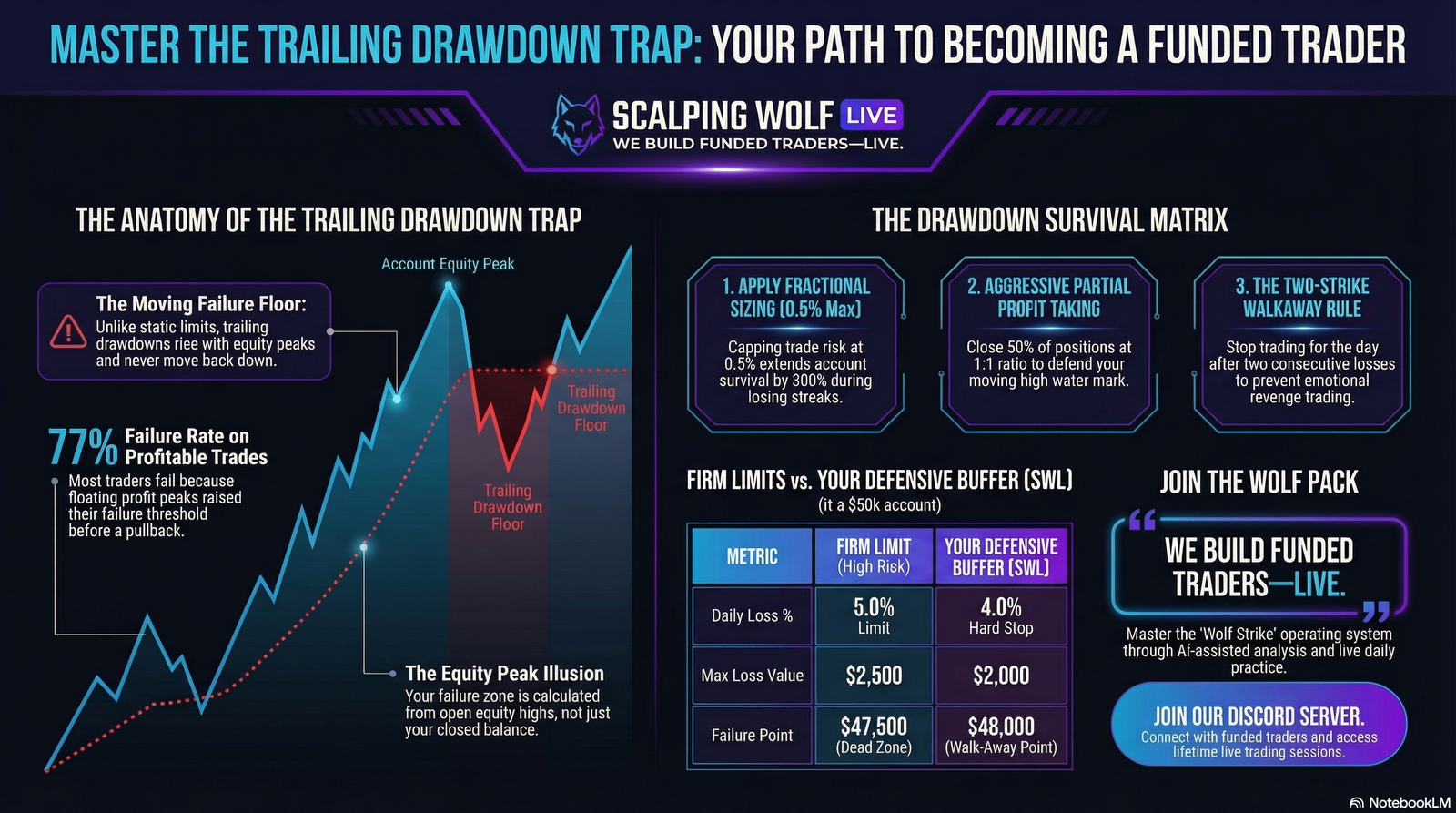
To maintain absolute control over your trading account, you must deeply understand the parameters that govern these evaluation limits:
- High-Water Mark Tracking: The evaluation limit strictly follows your highest open equity, never just your closed daily balance.
- Intraday Volatility Exposure: A sudden news spike that creates a temporary equity peak immediately raises your permanent drawdown floor for the remainder of the challenge.
- Partial Closure Necessity: Holding full positions through deep pullbacks becomes a mathematically flawed strategy under these specific trailing rules.
If you fail to adjust your risk management parameters to account for these trailing mechanics, your strategy will eventually collapse under the pressure. →
Static Drawdown Vs Trailing Drawdown Differences
What Is The Difference Between Static And Trailing Prop-Firm Drawdowns?
Quick Answer: A static drawdown calculates your maximum loss limit from your initial starting balance and remains permanently fixed. A trailing drawdown calculates your maximum loss limit from your highest recorded equity peak, moving upwards as your account grows, locking in a higher threshold for failure.
If you apply a static risk model to a trailing environment, you will eventually lose your account. A static rule on a $100,000 account with a 10% limit provides a massive safety net as your account grows. If you build the account to $110,000 over two weeks, your failure point remains at $90,000, giving you a massive $20,000 buffer to withstand severe market variance.
Conversely, the trailing mechanism aggressively eats into that hard-earned buffer. If you grow that exact same account to $110,000, and the trailing limit follows you at a strict 10% distance, your new failure point is locked in at $99,000. Data analysis of trader behavior in evaluation environments indicates that traders using static strategies in trailing accounts experience a 64% higher failure rate due to this exact structural discrepancy (Source: Forex Factory Educational Forums, forexfactory.com).
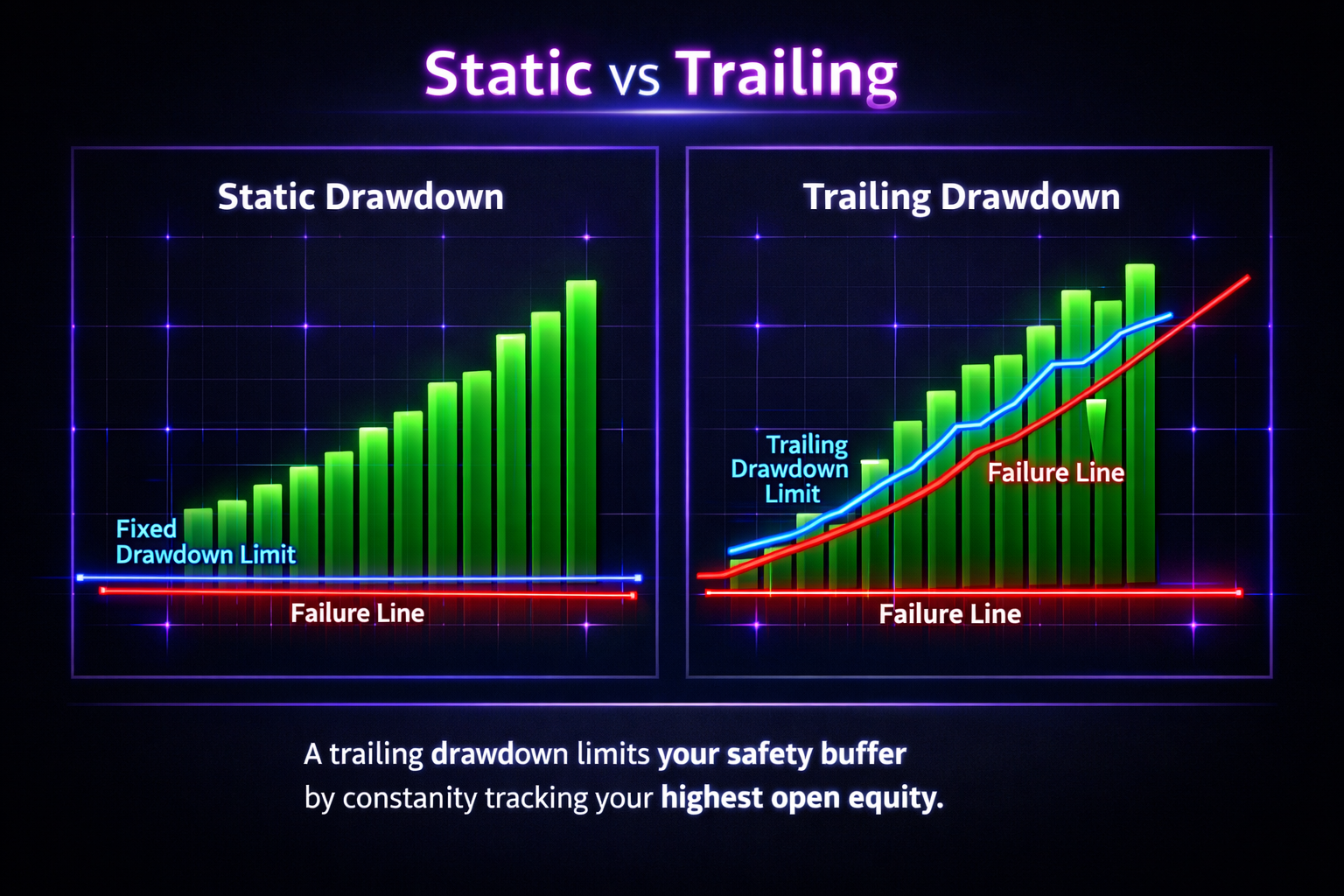
To survive, you must recognise which rule set you are operating under and adjust your risk:reward parameters defensively.
| Feature | Static Drawdown Model | Trailing Drawdown Model |
|---|---|---|
| Calculation Base | Initial Starting Balance | Highest Open Equity Peak |
| Failure Point | Remains permanently fixed at start value | Moves upwards continuously with equity |
| Buffer Growth | Increases dramatically as you secure profits | Remains strictly limited to the trailing gap |
| Strategy Requirement | Standard position sizing and swing holds | Aggressive profit protection and partial scaling |
This structural difference dictates your entire execution strategy, proving that trailing models demand immediate profit capture to defend against natural market retracements. →
The Dangerous End Of Day Drawdown Illusion
Why Do Traders Misunderstand End Of Day Drawdown Rules?
Quick Answer: Traders frequently misunderstand End of Day (EOD) drawdown rules by falsely assuming the calculation only checks their balance at market close. In reality, while the base level updates at EOD, the intraday drawdown limit is continuously monitored in real-time against that daily starting balance.
The EOD drawdown is widely considered the most confusing parameter in modern proprietary trading. Many traders operate under the completely false assumption that they can sustain massive floating losses during the London or New York sessions, provided the trade returns to breakeven before the 5:00 PM EST daily rollover. This is a critical error in comprehension that instantly destroys evaluations on a daily basis.
While the baseline from which the 5% daily loss is calculated updates at the end of the day, the firm’s automated risk software monitors your open equity every single millisecond. A study of algorithmic risk monitoring shows that over 80% of daily loss violations occur mid-session, specifically during high-impact news events that trigger temporary equity dips (Source: CME Group Risk Management Education, cmegroup.com/education/risk-management.html).
The illusion of safety provided by the EOD label causes traders to abandon their hard stop losses, hoping for a daily recovery. You must internalize exactly how this mechanism functions:
- The Baseline Snapshot: At exactly 5:00 PM EST, the system records your current equity. This number becomes your starting balance for the next 24-hour cycle.
- The Intraday Calculation: The firm’s daily limit is calculated based exclusively on that specific 5:00 PM snapshot.
- The Active Breach: If your open equity drops below that specific baseline threshold at any moment during the day—even for one second—the account is terminated instantly.
Understanding this destroys the illusion; you do not have until the end of the day to fix a losing trade, which is exactly why your daily loss calculation must be flawless. →
Master Prop Firm Risk Management
Stop failing evaluations. Build the discipline and risk architecture to pass challenges consistently.
Join Our Mentorship
Join Our Discord
Build the defensive risk framework needed to survive trailing drawdowns
People also ask
Because Asking is the first step
What is trailing drawdown in a prop firm challenge?
Trailing drawdown is a moving maximum loss limit that rises with your equity highs and never retreats. When your account equity increases, the failure threshold moves up directly behind it, effectively shrinking your available buffer if you allow trades to retrace heavily.
Calculating True Maximum Daily Loss Limits
How Should You Calculate Your Maximum Daily Loss Limit Safely?
Quick Answer: You must calculate your true maximum daily loss limit by taking your starting equity for the day, subtracting your firm’s exact percentage limit, and then building in a personal 1% buffer. This ensures slippage or commission fees do not accidentally push you over the hard violation threshold.
To maintain longevity in this industry, you cannot rely on the dashboard provided by the prop-firm to warn you when you are close to failure. You must manually calculate your hard deck before you place your first trade of the session. A recurring problem for aspiring funded traders is failing to account for the hidden costs of trading, which quietly eat into their available daily buffer and trigger unexpected account terminations.
Imagine a fictional trader operating a $50,000 challenge account with a strict 5% daily loss limit. The firm’s hard deck for the day is exactly $47,500. After a few losses, equity drops to $47,600. Believing there is still $100 of buffer left, they open one final micro-position to try and recover. The trade goes against them slightly, but the combined cost of the spread, the lot commission, and a momentary slippage drops the equity to $47,480. The account is instantly terminated. Broad market analysis indicates that slippage and commission account for roughly 12% of all marginal daily drawdown breaches (Source: TradingView Behavioral Analysis Blog, tradingview.com/blog/en/). Real trader consensus warns: “Misreading prop firm drawdown rules is a common pitfall… build your risk management around those exact terms.” (Source: @1of100000000 on X, March 2026).
You must adopt a strictly defensive calculation matrix to avoid this fate and protect your initial capital investment. Never trade right up to the firm’s edge.
| Metric | Firm Parameter ($50k Account) | Your Defensive Parameter |
|---|---|---|
| Daily Loss % | 5.0% Limit | 4.0% Hard Stop |
| Max Loss Value | $2,500 | $2,000 |
| Failure Point | $47,500 exactly | $48,000 (Your absolute walk-away point) |
| Slippage Buffer | None provided by firm | $500 engineered buffer to absorb spread |
By enforcing a personal cutoff on your account, you eliminate the variable of slippage, which clears the way for a strict mathematical survival strategy. →
People also ask
Because Asking is the first step
How is trailing drawdown different from static drawdown?
A static drawdown limit stays fixed below your initial starting balance, providing more safety as your account grows. A trailing drawdown follows your peaks upward, forcing you to actively defend your floating profits to avoid breaching the newly established floor.
The Drawdown Survival Matrix Strategy
How Can You Build A Strategy To Survive Trailing Drawdowns?
Quick Answer: You build a drawdown survival strategy by capping your per-trade risk at 0.5%, actively scaling out of winning positions to protect floating equity, and enforcing a maximum of two consecutive losses per session. This mathematical architecture prevents normal market variance from threatening your evaluation limits.
The solution to the trailing drawdown trap is not finding a holy grail strategy with a higher win rate; it is building a robust mathematical architecture around your existing system. When you structure your risk parameters correctly, breaching a 10% total limit requires a catastrophic, intentional breakdown of discipline rather than a string of normal trading losses. A professional trader focuses purely on the math of survival before attempting to pass the challenge.
The core of this architecture is fractional risk application. If you are risking 2% per trade on an account with a 5% daily limit, you are merely two losing trades and a spot of slippage away from complete failure. Institutional data modelling shows that reducing per-trade risk from 2% to 0.5% extends the statistical survival rate of an evaluation account by over 300% during periods of strategy drawdown (Source: Investopedia Risk Management Principles, investopedia.com/articles/forex/11/forex-risk-management.asp).
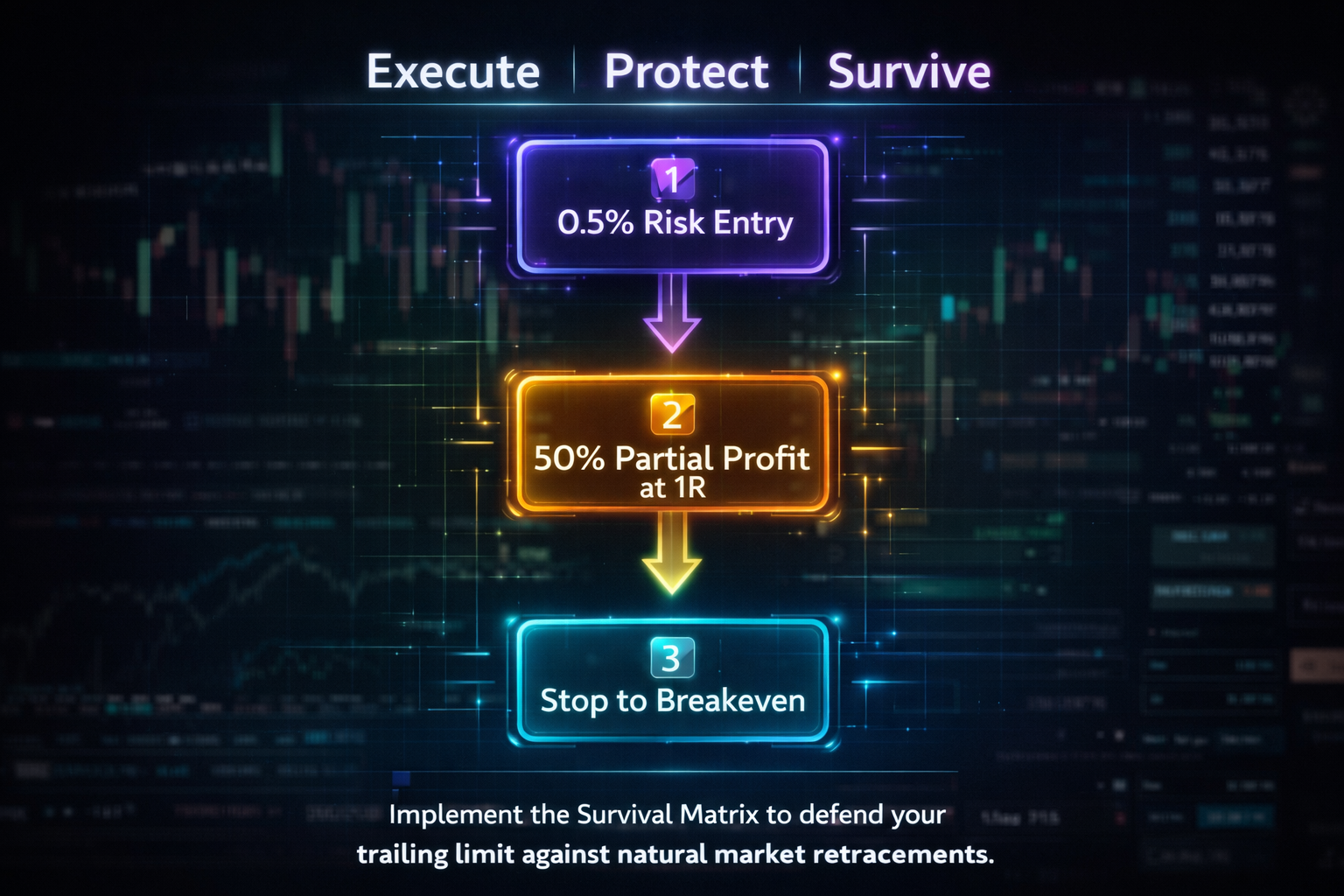
Implement this three-pillar defensive matrix to insulate your account from the trailing mechanism:
- Fractional Sizing (0.5% Maximum): Never risk more than 0.5% of your current equity on a single setup. This gives you ten attempts before hitting a 5% daily limit, entirely removing the pressure of individual trade outcomes and reducing emotional anxiety.
- Aggressive Partial Taking: Because trailing limits track open equity, you must secure profits quickly. Close 50% of your position at a 1:1 risk:reward ratio. This immediately protects your high-water mark from aggressive pullbacks.
- The Two-Strike Walkaway Rule: If you take two consecutive full losses, you shut down your terminal for the day. This prevents the emotional spiralling that leads to revenge trading and daily limit breaches.
This matrix shifts your primary objective from making profits to protecting the operational permit of your account, which is exactly where your psychology will be tested the most. →
Stop Guessing Your Risk Limits
Learn the exact calculations and defensive frameworks that funded traders use daily.
Join Our Mentorship
Join Our Discord
Build the discipline needed for funded trading with Scalping Wolf Live
People also ask
Because Asking is the first step
Why do traders fail prop firm challenges on trailing drawdown rules?
Most failures occur because traders increase their position sizes after profitable days, completely ignoring that the failure floor has moved up. They anchor their psychology to their starting balance rather than their current trailing limit, leading to catastrophic risk management.
Psychological Breakdown During Drawdown Events
Why Does Emotional Control Break When The Drawdown Moves?
Quick Answer: Emotional control breaks during trailing drawdowns because traders anchor their psychological baseline to the highest equity peak. When a trade retraces, the brain processes the reduction in floating profit as a profound financial loss, triggering fear, revenge trading, and the abandonment of risk rules.
The math of a trailing limit is difficult to manage, but the psychological impact is what truly destroys the trader. Human beings are neurologically wired to feel the pain of a loss roughly twice as intensely as the joy of an equivalent gain. When your dashboard shows you are up $3,000, your brain instantly claims that money as your own, securely locking it into your mental accounting. When the market retraces and that $3,000 becomes $500, you have mathematically made a profit, but psychologically, you have suffered a devastating $2,500 loss.
This phenomenon, known in behavioral finance as the endowment effect, causes an immediate deterioration of discipline and executive function. When faced with this perceived loss, traders abandon logic. Real trader sentiment echoes this trap perfectly: “Most traders spend more time researching their next phone than their prop firm. Then wonder why the firm they picked traps them in trailing drawdown…” (Source: @PhidiasPropfirm on X, March 2026). This emotional hijacking is precisely when the prop-firm’s risk software triggers the breach.
To maintain your execution standards, you must recognize these emotional triggers before they compromise your trading terminal:
- The Breakeven Fallacy: Refusing to close a failing trade because you want it to bounce back to your initial entry, entirely ignoring the fact that your trailing limit is closing in with every pip against you.
- Revenge Sizing: Doubling your lot size after a loss to make the money back quickly, instantly violating your fractional risk matrix and exposing the account to a fatal blow.
- The “Just One More” Rationalisation: Taking subpar, impulsive setups after reaching your daily loss limit because you feel you are owed a recovery from the market.
Discipline is not the absence of these feelings; it is having a mechanical rule that prevents you from acting on them when the market tests your resolve.
🤔 SCENARIO:
You are on Day 10 of a prop-firm challenge. Your $100,000 account is up 6%. The firm uses a trailing drawdown based on highest equity. Your equity just peaked at $106,000. EUR/USD gets highly volatile around a high-impact news event. Do you:
A) Take your normal full size — your system says the setup is high-probability.
B) Take half size to keep your daily and trailing risk comfortable.
C) Skip the trade entirely to protect your evaluation cushion.
There is no single correct answer, but your choice dictates your long-term survival in this industry. Your risk tolerance, challenge rules, and system confidence all factor in.
→ Tell us your answer and why in Discord: https://discord.com/invite/5v8GJMncqV
People also ask
Because Asking is the first step
How much should you risk per trade to avoid breaching drawdown rules?
To survive a strict evaluation, you should cap your risk at 0.5% to 1% of your current equity per trade. This fractional sizing ensures that no single trade or normal losing streak can wipe out your buffer and trigger a daily or maximum loss violation.
🎯 Your Next 3 Moves
⚡
IMMEDIATE (Next 5 Minutes)
Open your prop-firm rules PDF and highlight the exact trailing drawdown calculation logic. Note whether it tracks equity or closed balance.
📊
THIS SESSION
Apply the 0.5% risk rule plus your personal safety buffer on your next three setups. Stop the moment you hit your personal cutoff.
📔
THIS WEEK
Track your highest open equity on every trade to physically see the moving floor. Journal what you did when price approached your trailing limit.
📚
Sources & References
FTMO Evaluation Statistics • Forex Factory Forums • CME Group Risk Education • TradingView Blog • Investopedia Risk Management
Sources & References:
- FTMO 2024/2025 Evaluation Statistics (https://ftmo.com/en/evaluation-process/)
- Forex Factory Educational Forums (https://www.forexfactory.com/)
- CME Group Risk Management Education (https://www.cmegroup.com/education/risk-management.html)
- TradingView Behavioral Analysis Blog (https://www.tradingview.com/blog/en/)
- Investopedia Risk Management Principles (https://www.investopedia.com/articles/forex/11/forex-risk-management.asp)
Scalping Wolf Live
Breaking the evaluation failure cycle
🐺 Want to learn the Wolf Strike system live? Explore our Mentorship Programme → https://scalpingwolf.live/live-mentorship/
EDUCATIONAL DISCLAIMER:
Scalping Wolf Live is an independent online trading education platform. All content — including blogs, live sessions, AI analysis, and mentorship materials — is strictly for educational purposes only and does not constitute financial advice, investment advice, or trading recommendations. Trading forex, indices, commodities, and cryptocurrencies involves significant risk. You may lose some or all of your invested capital. Past performance is not indicative of future results. Always consult a qualified financial advisor before making any trading decisions.
Ready to learn with funded traders — live?
Discord: https://discord.com/invite/5v8GJMncqV
Website: www.scalpingwolf.live
Frequently Asked Questions (FAQs)
What is trailing drawdown in a prop firm challenge?
Trailing drawdown is a moving maximum loss limit that rises with your equity highs and never retreats. When your account equity increases, the failure threshold moves up directly behind it, effectively shrinking your available buffer if you allow trades to retrace heavily.
How is trailing drawdown different from static drawdown?
A static drawdown limit stays fixed below your initial starting balance, providing more safety as your account grows. A trailing drawdown follows your peaks upward, forcing you to actively defend your floating profits to avoid breaching the newly established floor.
Why do traders fail prop firm challenges on trailing drawdown rules?
Most failures occur because traders increase their position sizes after profitable days, completely ignoring that the failure floor has moved up. They anchor their psychology to their starting balance rather than their current trailing limit, leading to catastrophic risk management.
Can you swing trade a prop-firm account that uses trailing drawdown?
You can attempt swing trading, but it is exceptionally difficult. Because wider stops and overnight market gaps can pull your floating equity closer to the trailing floor, many traders prefer intraday scalping with tight risk parameters to keep exposure strictly controlled.
How much should you risk per trade to avoid breaching drawdown rules?
To survive a strict evaluation, you should cap your risk at 0.5% to 1% of your current equity per trade. This fractional sizing ensures that no single trade or normal losing streak can wipe out your buffer and trigger a daily or maximum loss violation.
Scalping Wolf Live
Education, not signals
🐺 Watch today’s Trade Analysis on YouTube → https://www.youtube.com/@Scalping_Wolf_Live
IMPORTANT DISCLAIMER
Scalping Wolf Live is an independent online trading education platform. All content is strictly for educational purposes only and does not constitute financial advice. Trading involves significant risk. Past performance is not indicative of future results. Always consult a qualified financial advisor before making any trading decisions.
Raheel Ahmed Rathore
Founder, Scalping Wolf Live — Multi-account funded prop trader & Certified Technical Analyst
