

Introduction to Forex Trading
A concise, friendly introduction to forex trading: what it is, how it works, key strategies, and practical first steps for beginners plus a scalping-focused lens.

Table of Contents
💡 QUICK ANSWER: What is Forex Trading?
Forex (FX) trading is the buying and selling of currencies to profit from exchange-rate moves. Most retail traders use leverage, technical analysis, and short timeframes (scalping, day trading) or longer-term macro approaches; risk management and a tested plan are essential. For live mentorship and a rules-first 1-minute scalping system you can explore Scalping Wolf Live.
Join Us Now
Start your forex trading journey with proven strategies and live community support.
Begin your transformation in forex trading today with Scalping Wolf Live
Because Asking is the first step
What is scalping and is it suitable for beginners?
What is Forex? (Basic Definition)
Forex is the global market where currencies are exchanged and priced.
It operates 24/5 across major sessions (Tokyo, London, New York) and is the world's largest financial market by daily volume. Currencies trade in pairs (e.g., EUR/USD). One currency is bought while another is sold; traders profit when the pair moves in their predicted direction. Liquidity and tight spreads make FX suitable for short-term strategies like scalping.
Unlike stock markets with fixed trading hours, forex trading never sleeps. Whether you're in Asia, Europe, or North America, there's always an active trading session. This 24-hour availability makes forex attractive for traders worldwide who want flexibility in their trading schedule.
Key characteristics of the forex market:
- Massive volume: Over $6 trillion traded daily, ensuring high liquidity.
- Tight spreads: The gap between bid and ask prices is minimal, especially for major pairs.
- Leverage available: Brokers offer leverage, allowing traders to control larger positions with smaller capital.
- Accessibility: Low minimum deposits and 24/5 trading hours make it accessible to retail traders.
- Predictability: Fundamental factors (interest rates, economic data) drive currency movements, making analysis systematic.
Master these foundations, and you're already ahead of most traders. Let's dive deeper into how the market actually works. →
🎬 Introduction to Forex Trading
Watch this comprehensive introduction to forex trading, covering what it is, how it works, and key trading styles for beginners.
How Forex trading works (step-by-step)
Choose a currency pair — majors like EUR/USD, GBP/USD, USD/JPY have high liquidity.
Pick direction — go long (buy) if you expect base currency to strengthen; short (sell) if you expect it to weaken.
Use leverage — brokers offer leverage (e.g., 1:50 to 1:500); it magnifies gains and losses.
Apply risk management — set stop-loss and take-profit; risk a small % of equity per trade (commonly 0.5–2%).
Execute and monitor — enter on your signal and manage trade according to plan.

Understanding downtrends and proper entry points.
:max_bytes(150000):strip_icc()/GettyImages-1241209250-489e01d8f12a4e7484c7ed784a3049ae.jpg)
Professional trading terminals for execution.
Key Principles for Successful Trading:
- Start with a demo: Practice on a risk-free demo account to validate your strategy.
- Use reliable brokers: Choose brokers with low spreads, fast execution, and good regulation.
- Set stop losses: Always protect your capital by defining your maximum loss per trade.
- Risk management: Risk only a small percentage of your account per trade (0.5–2%).
- Keep a journal: Track every trade to identify patterns and improve your edge.
If you follow these core principles consistently, you are building the discipline needed for successful trading. Mentorship and live community support accelerate this learning curve significantly.
Join Us Now
Start your forex trading journey with proven strategies and live community support.
Begin your transformation in forex trading today with Scalping Wolf Live
Because Asking is the first step
How much should I risk per scalp trade?
Emotional discipline is key to profitable trading.
Effective risk management protects your capital.
The Basic Setup Checklist:
- Broker: Do you have a regulated forex broker account? (Yes/No)
- Trading Platform: Do you have access to MetaTrader 4 or 5 or similar? (Yes/No)
- Demo Account: Have you practiced on a demo account first? (Yes/No - Highly Recommended)
- Risk Plan: Do you have a documented risk management plan? (Yes/No)
Answer "Yes" to all these, and you're ready to start your forex trading journey safely. Let's explore how successful traders work in real market conditions. →
Because Asking is the first step
Can I trade forex with a small starting capital?
Common trading styles
Scalping: dozens–hundreds of trades per day, tiny targets (a few pips), fast execution. Requires low spreads and fast data feeds.
Day trading: holds trades minutes–hours, avoids overnight risk.
Swing trading: holds days–weeks on medium-term trends.
Position trading: weeks–years, driven by macro events.
Scalping is viable but high-stress and rule-driven; many mentors and programs (including live mentorships) emphasize practice, strict rules, and edge-building.
Technical vs Fundamental analysis
Technical analysis uses price, volume, indicators (EMA, RSI), chart patterns, and order-flow observations. Many scalpers rely mostly on technical setups and micro-structure cues.
Fundamental analysis looks at macro releases (NFP, CPI), interest-rate differentials, and geopolitical events. Day traders combine both: use fundamentals for bias and technicals for entries.
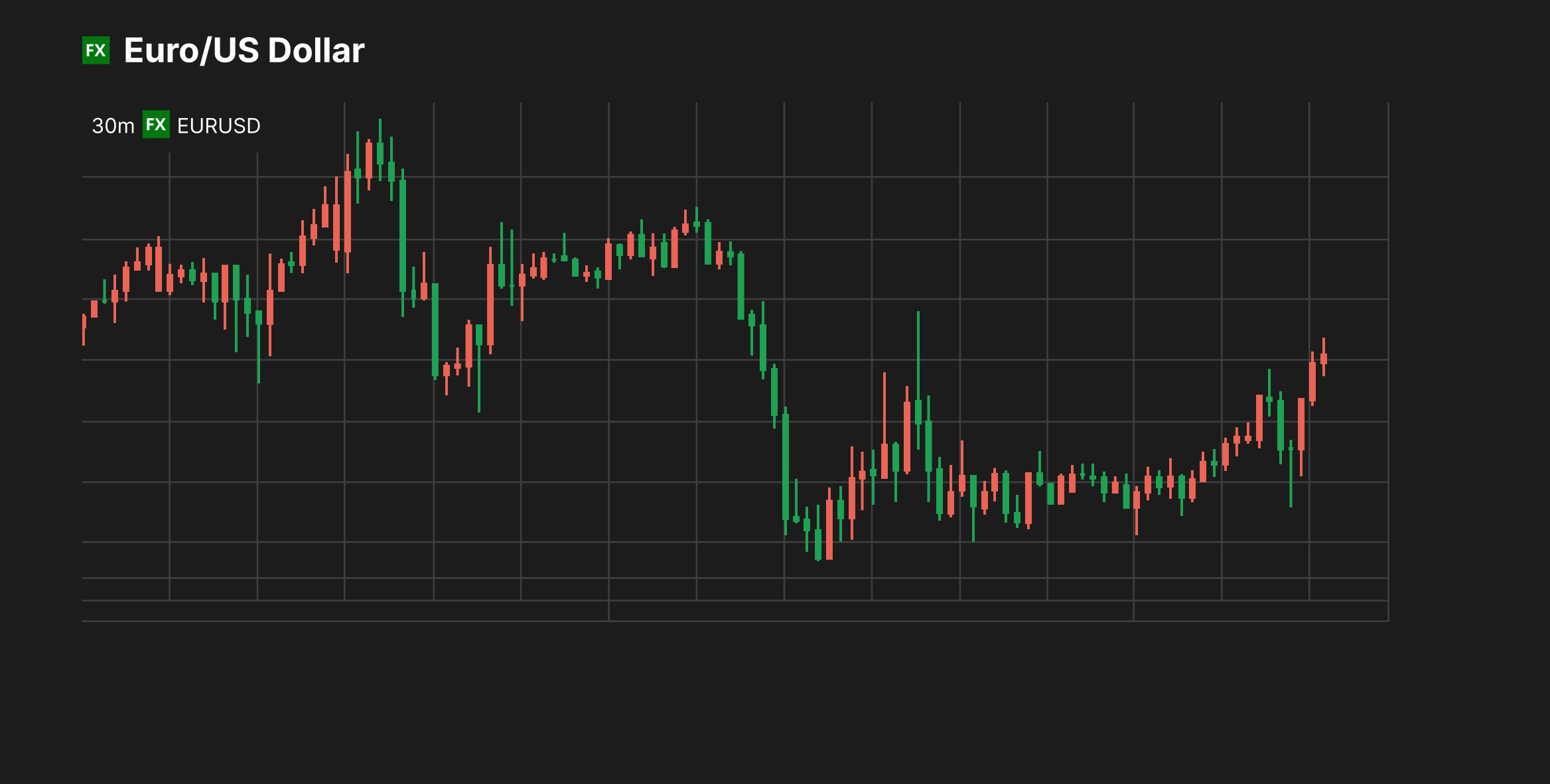
Key tools you'll need
- Reliable broker with low spreads and fast execution.
- Trading platform: MetaTrader 4/5, TradingView, or proprietary platforms.
- Charts and indicators: EMAs, VWAP, order-flow tools for scalp traders.
- A demo account for strategy validation.
- Journal / analytics to track win rate, expectancy, and drawdowns.
Because Asking is the first step
What are the best technical indicators for forex trading?
Scalping Setup: Your First Live Trade
What equipment and settings do you need to start scalping?
Quick Answer: A regulated broker with low spreads, MetaTrader 4 or 5, a stable internet connection, a scalping EA or manual trading discipline, and a clear risk management plan. Most successful scalpers use 1-minute to 5-minute charts and focus on major pairs like EUR/USD.
Once you've set up your broker account and validated your strategy on a demo, the next critical step is execution. Successful scalpers execute with precision, managing each trade in seconds without emotion. Entry signals must be clear and repeatable; position sizing must align with your 1% risk rule; and exit discipline must be non-negotiable.
For full-time scalpers, this execution happens continuously throughout the trading day. London, New York, and Tokyo sessions each offer volatility. The key is to match your scalping strategy to the session characteristics: London opens with tight spreads and high volume; New York overlaps bring volatility spikes; Tokyo offers steady moves on lower volume. Professional scalpers execute 10–50 trades per session, managing risk tightly and tracking every KPI religiously.
The speed and systematic nature of scalping demands discipline and real-time monitoring. This is why community and mentorship matter so much. Live chat rooms, trade reviews, and peer accountability help you stay on your rules when emotions tempt you to deviate. At Scalping Wolf Live, this shared experience and feedback loop is built into every session.
| Pair | Typical retail spread (pips) | 1 pip value per standard lot (100,000 units) | Comment |
|---|---|---|---|
| EUR/USD | 0.1–1.5 | $10 | Most liquid major, ideal for scalping |
| GBP/USD | 0.2–2.0 | $10 | Wider swings, higher volatility |
| USD/JPY | 0.1–1.2 | $9–10 | Lower volatility, good during sessions |
| AUD/USD | 0.3–2.5 | $10 | Commodity-linked, session-sensitive |
| USD/CHF | 0.3–2.0 | $10 | Correlated with EUR pairs at times |
Study these pairs closely. Mastering one pair deeply (e.g., EUR/USD) is better than spreading yourself thin across many. Let's now explore the financial and psychological realities of scalping. →
Join Us Now
Start your forex trading journey with proven strategies and live community support.
Begin your transformation in forex trading today with Scalping Wolf Live
Conclusion (short)
Forex trading offers real opportunities but demands preparation. Scalping can be profitable if you combine a rules-first system, tight execution, strong risk controls, and disciplined performance tracking. Start small, demo extensively, and prefer mentorship or peer review before scaling live capital.
Interactive engagement (mini-quiz + call-to-action)
Mini-quiz — choose one and see recommended next step:
A) I prefer high activity, fast decisions → Try a structured 1-minute demo routine, focus on 100 trades to collect solid KPI data.
B) I like measured trades and more time → Start with 15m/1h swing strategies and paper-trade 30 setups.
C) I want mentorship → Join a live class or community where trades are reviewed; attend at least 3 live sessions before funded account attempts.
How much will scalping cost you? The answer depends on your broker's spreads and your position sizing. If you trade a 0.1 standard lot on EUR/USD with a 1-pip spread, your cost is $1 per trade. Trade 100 times per day and you're paying around $100 in spread costs—a real but manageable expense if you're managing wins over losses.
The financial reality of trading is that you will have losing days, and losing weeks. This is normal. What separates winners from losers is how they manage those losses. A trader who loses 2% on a bad day but respects their stop losses will recover in one good day. A trader who breaks their rules and holds losers can lose 20% before they panic-exit. This is why a documented risk plan is non-negotiable.
Transparency matters here too. Some brokers offer tight spreads but have slippage on execution. Others charge commissions but have better fills. Test your broker on a demo account for at least 50 trades before funding it. Pay attention to slippage, spread consistency, and withdrawal speed. Your choice of broker can add or subtract 10–20% of your edge over time, so choose carefully.
Strict Entry Rules
Define exact conditions before you trade—no exceptions, no feelings.
Track Every Metric
Win rate, profit factor, Sharpe ratio, drawdown—measure everything rigorously.
Ask for Help
When stuck, reach out to mentors and the Scalping Wolf Live community for guidance.
Know Your Limits
Scalping Wolf Live teaches forex trading. We do not provide investment advice or manage funds.
Master these fundamentals, and you're ready to join thousands of traders who've turned scalping into consistent income. The difference between a profitable trader and a struggling one usually comes down to discipline, not luck. →
Ready to get started?
Your forex trading journey begins with the right mindset, proven strategies, and ongoing support from experienced mentors. At Scalping Wolf Live, we provide exactly that through our rules-first 1-minute scalping system, detailed KPI tracking education, and a supportive community of active traders. Whether you prefer day trading, swing trading, or aggressive scalping, we have resources and live mentorship to accelerate your learning while protecting your capital.
The key is to start small on a demo account, validate your edge with real data, and scale systematically. Our mentors have walked this path themselves; we don't preach theory in isolation—we trade live and show you real examples of entries, exits, and psychology workthrough every single day.
FAQs (concise)
Q: Do I need a lot of money to start forex?
Q: Which broker is best for scalping?
Q: Are automated EAs safe for scalping?
Q: Should I follow a paid signal service?
Forex trading involves substantial risk and is not suitable for all investors. Past performance is not indicative of future results. Before trading, ensure you understand the risks and have adequate capital. Scalping Wolf Live provides educational content and mentorship; always engage with a demo account before risking real capital.
Scalping Wolf Live
Forex Trading Mentorship & Live Community
