





1 Minute Scalping Strategy Rules: Filter Noise First 2026
A rules-first guide to turning urgent one-minute candles into calm, evidence-led trade or no-trade decisions.
A rules-first guide to turning urgent one-minute candles into calm, evidence-led trade or no-trade decisions.

On this page

A 1 minute scalping strategy should filter context, location, trigger, invalidation, execution cost and account risk before any order is considered. Use the one-minute chart for timing, not as the whole decision. Mark the location first. Define what cancels the idea. Check spread, commission, slippage and event conditions. If one mandatory input is missing, record no trade. The process cannot remove losses, but it can make each decision consistent, reviewable and harder to rewrite after the result.
- Use the one-minute chart for timing, not as the entire trading decision.
- Require context, location, trigger and invalidation before execution is considered.
- Check spread, commission, slippage and scheduled-event conditions before entry.
- Treat a missing mandatory input as a recorded no-trade decision.
Scalping Wolf Live provides trading education built around structured analysis, disciplined risk thinking and live learning. For this topic, its useful role is helping you practise a written entry gate rather than following an impulsive one-minute candle. Review the rules-based scalping education and keep every final trading decision your own.
The candle expands. Price looks ready to leave. Your hand moves towards the order button because waiting feels like losing. That pressure is familiar, but speed is not evidence. The painful part is often not a losing trade; it is realising afterwards that you never checked the conditions meant to protect the decision. This guide gives you a six-gate filter for context, location, trigger, execution, risk and no-trade discipline. The final gate is the one that separates a planned scalp from a story invented by an urgent chart.
Context Before One-Minute Execution
Why should context come before one-minute entry timing?
Context decides whether your one-minute trigger is even eligible. Classify the wider condition, mark the intended decision area and check scheduled events before opening the execution view. The smaller chart may then time a written setup, but it should not be allowed to invent direction, location and urgency at once.
The Bank of England lists eight confirmed Monetary Policy Committee announcement dates for 2026. One calendar can therefore change the conditions around many apparently ordinary candles. The date never predicts direction; it simply gives you verified information for deciding when your own event rule makes the setup inactive.
Imagine a fictional trader preparing for a prop-firm evaluation. The market has been quiet, and the first expanding candle feels like relief. They have spent the session waiting, so the movement seems to demand action. Yet the marked zone is still below price, the event check has not been completed and the spread is wider than the records used in practice. The story in their mind says opportunity; the written gate says incomplete. Choosing no trade may feel uncomfortable, particularly if price later continues, but the decision remains faithful to evidence available before the outcome.
- Classify the condition: trend, balance or disorder.
- Mark the decision zone before price reaches it.
- Check the official event calendar and your own tested event rule.
- Write what invalidates the wider idea.
Once the wider story grants permission, the next test is whether price arrives at a location you actually planned.
Location, Trigger and Invalidation
How do you separate a trigger from noise?
A trigger becomes meaningful only at a pre-marked location and with a pre-written invalidation. Define what price must do, whether a candle must close and what event cancels the premise. If the move occurs away from the zone or after the planned entry has passed, treat it as late rather than chase it.
A location is a decision area, not a promise of reversal or continuation. Use one permitted directional condition, one observable trigger and one invalidation event. This three-part record is deliberately small: adding a fourth indicator after the candle moves can turn confirmation into hindsight instead of better evidence.
Now imagine the same trader on another session. The wider condition is classified, price reaches the pre-marked area, the written trigger completes and invalidation is clear. The bid and ask remain inside the tested cost boundary, account capacity is known and no external restriction blocks the method. The gate may permit consideration of the order. That permission is not confidence theatre. The trade can still lose normally, slip or behave differently from historical examples. What changed is not certainty; it is that the decision can be reconstructed without inventing missing reasons afterwards.
- Location: the area marked before urgency appears.
- Trigger: the observable event that must complete.
- Invalidation: the event proving the premise no longer holds.
- Late-entry rule: reject the original setup once its planned opportunity has passed.
A clean trigger can still become a poor decision when the cost of reaching and leaving the market changes.
Rehearse the same written checks on historical or simulated setups, preserve every rejection and ask for feedback on your process rather than a prediction. Scalping Wolf Live’s live mentorship information explains its education-led environment. Your evidence should still show why context, location, trigger, cost and risk passed or failed.
Spread, Slippage and Execution Quality
Why can execution costs invalidate a clean setup?
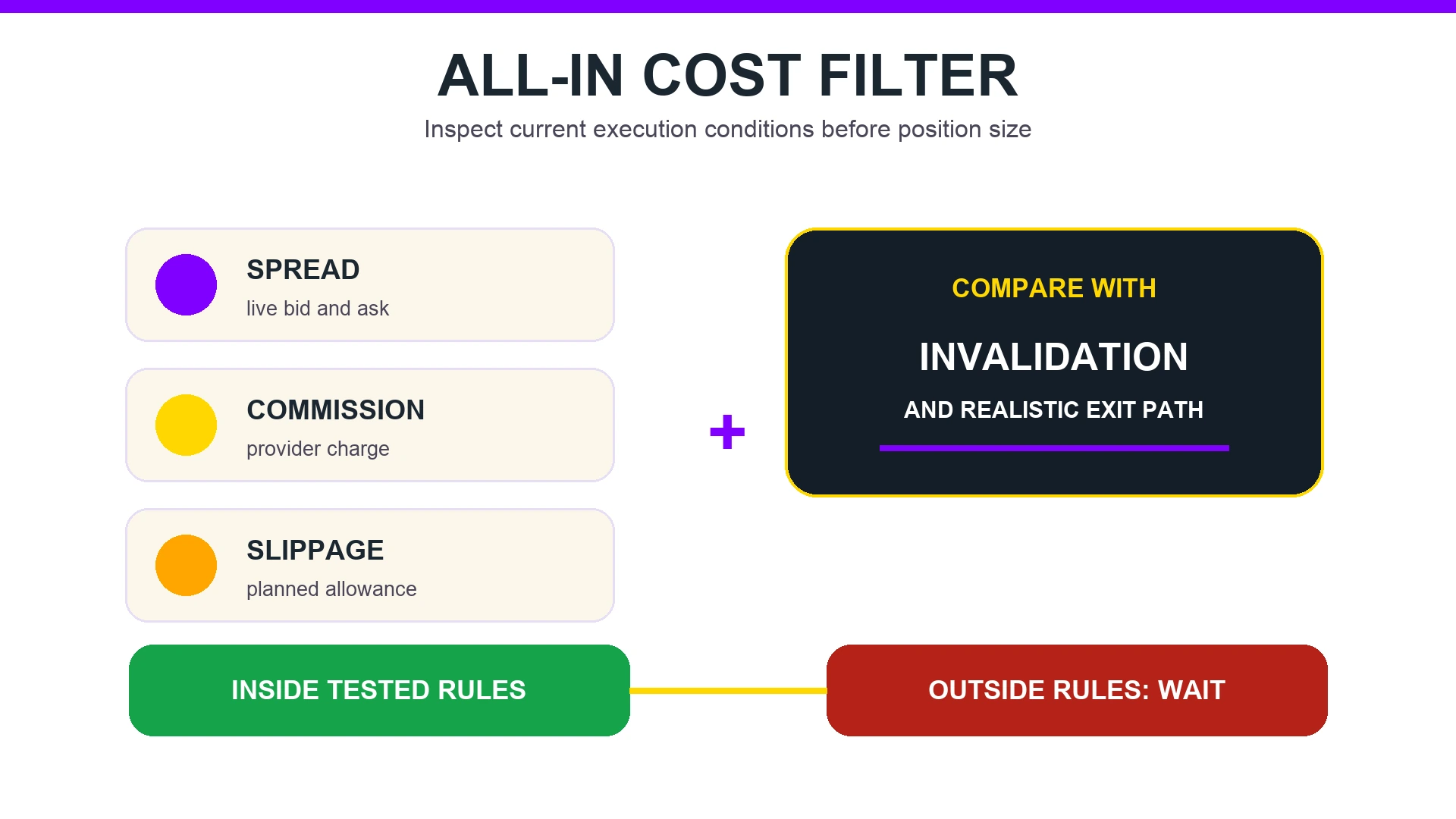
Short opportunities are especially sensitive to spread, commission, slippage and available liquidity. Compare the live bid and ask, expected fees, invalidation distance and realistic path before ordering. If costs fall outside the boundary tested for your venue and instrument, the chart pattern has not passed the complete gate.
CME Group’s methodology measures bid-ask spread and cost to trade at each order-book update from April 2024. It also states that larger fixed quantities may consume more than the top level. That evidence explains why a displayed candle alone cannot describe the complete execution environment you face.
This is why filtering noise does not mean deleting every small candle or finding an indicator that never disagrees. Noise is also decision noise: shifting the zone, accepting an unfinished trigger, ignoring costs because the candle looks strong, or changing the story after the result. A useful gate filters those behaviours. It narrows the question from ‘Will this move?’ to ‘Has my complete process earned permission under current conditions?’ That question is less exciting, but it is more honest and far easier to review.
- Observe bid and ask, not only the candle.
- Add spread and commission to the planned cost.
- Allow for venue-specific slippage without inventing a universal figure.
- Reject unstable quotes or conditions outside tested evidence.
After cost passes, the setup still needs permission from your position size, exposure and exact account rules.
Risk and Account Rules First
When should account limits stop a valid setup?
Account limits stop the setup whenever position size, open exposure, realised or floating loss, fees, event restrictions or provider terms make it ineligible. Calculate size only after invalidation and costs are known. A visually valid trigger never overrules the exact current rules for your named account and programme.
For UK retail CFDs, the Financial Conduct Authority says leverage limits range from 30:1 to 2:1 by underlying asset and positions close when funds fall to 50% of required margin. Those are regulatory boundaries for covered products, not a universal scalping template or a prop-firm rule.
Indicators may still have defined roles. A moving average can summarise recent price, and an oscillator can describe momentum under its own formula. Neither automatically supplies market context, account permission or a logical invalidation. If every new tool receives permission to override the previous one, the chart becomes a debate you can always win after the fact. Give each tool one job, define that job before the session and reject the setup when the required evidence conflicts or remains absent.
- Define invalidation before position size.
- Include all existing exposure and charges.
- Read the current official provider terms for the exact account.
- Apply personal limits inside, never outside, binding account restrictions.
With context, location, execution and risk defined, you can now turn the whole journey into one binary gate.

Begin away from live pressure. Choose one instrument, one context view and one written trigger, then practise the complete gate in replay or demo conditions. The Trading Pack can provide a learning route, but your immediate goal is not more trades. It is making no-trade decisions as deliberately as entries.
The Six-Gate No-Trade Checklist
What must pass before a one-minute order?
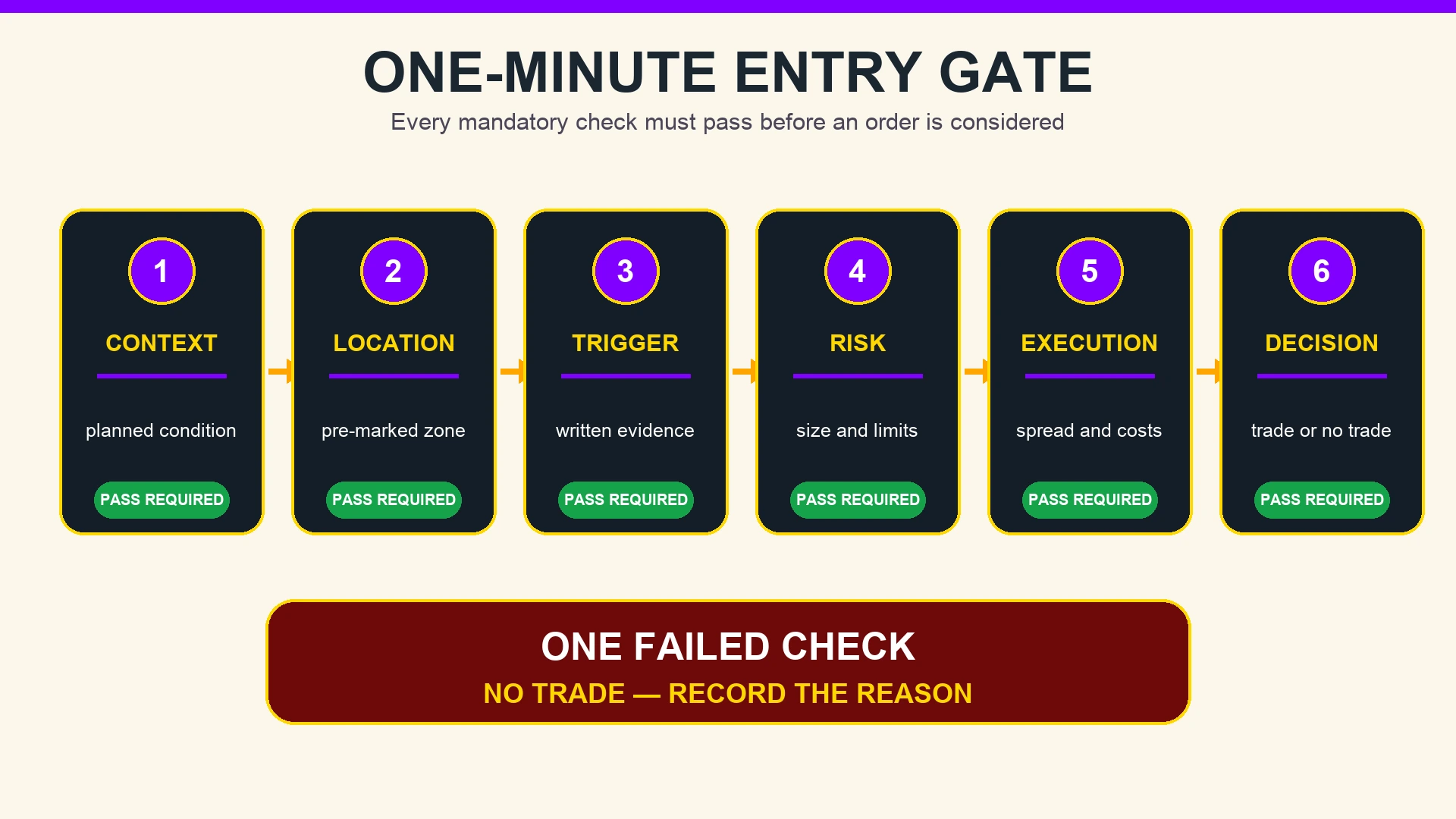
Six mandatory checks must pass: context, location, trigger, invalidation and risk, execution quality, and decision discipline. They are non-compensatory. Five strong answers cannot cancel one failed safety condition. A permitted result means the setup may be considered; it never means the trade is certain to succeed.
The CFTC reports that two out of three customers at registered over-the-counter forex dealers lost money in its cited Q2 2021 to Q1 2022 disclosures. The statistic is US-focused and historical, but it supports the wider lesson: rapid access and a convincing chart never remove leverage, cost or counterparty risk.
Provider rules deserve the same care. Reset logic, maximum-loss calculation, restricted techniques, event rules and holding conditions can differ by provider, programme, phase and account. Do not copy a headline threshold from another trader and treat it as yours. Read the current official terms, note the version or retrieval date and mirror the provider’s calculation basis in your worksheet. A personal limit can be stricter, but it cannot make a prohibited setup eligible.
- Gate 1: context and event status.
- Gate 2: pre-marked location.
- Gate 3: completed written trigger.
- Gate 4: invalidation, size and account capacity.
- Gate 5: spread, cost and platform conditions.
- Gate 6: ability to accept a loss or missed move without changing the rule.
The last discipline is to preserve what happened without letting profit or loss rewrite the quality of your choice.

Review Decisions Before Outcomes
How should you review a rejected one-minute setup?
Review the evidence available at the decision time before looking at profit or loss. Preserve accepted and rejected setups, rule-valid losses and rule-breaking wins as separate categories. Change one rule at a time, version it and test comparable records so one emotional outcome cannot redesign the entire process.
A six-field journal can capture context, location, trigger, invalidation, execution and final permission before outcome is known. That count is an original workflow choice, not a performance statistic. It matters because a rejected setup that later moves can still be a correct no-trade decision under the recorded evidence.
The story-led lesson is simple: the hero is not the candle and the guide is not a prediction. You are the decision-maker, and the written gate is the map that stops urgency changing the route. Scalping Wolf Live can provide education, structure and live accountability, but it cannot remove uncertainty or take responsibility for your order. The practical outcome of this guide is therefore a repeatable pause: six checks, one decision state and evidence saved before the result arrives.
- Save a before-decision screenshot.
- Record PASS or FAIL for every mandatory gate.
- Label outcome separately from process quality.
- Change one written rule per version.
- Keep missed moves and rejected setups in the evidence library.
That separation turns a fast chart into a slower learning loop you can rehearse, challenge and improve.
A fictional setup reaches your marked zone and completes its trigger, but spread is outside your tested boundary. Price then moves without you. What would you record: missed trade, correct rejection or rule to review—and what evidence supports that label?
A setup reaches your zone and triggers, but spread exceeds your tested boundary. What do you record, and what evidence supports that label?
Sources
- Financial Conduct Authority — Contract for differences (reviewed 2026-08-12)
- Commodity Futures Trading Commission — Eight Things You Should Know Before Trading Forex (reviewed 2026-08-12)
- Bank of England — Monetary Policy Committee dates for 2026 and 2027 (reviewed 2026-08-12)
- CME Group — Understanding the CME Liquidity Tool Methodology (reviewed 2026-08-12)
FAQs
Is a one-minute chart enough for a complete trading decision?
Should every one-minute trigger wait for a candle close?
What spread is acceptable for a one-minute scalping strategy?
Can a rules-based one-minute trade still produce a loss?
How often should I change my scalping entry checklist?
Is one-minute scalping suitable for a complete beginner?
No. A checklist cannot remove uncertainty, normal losses, slippage or provider risk. It can expose missing inputs and make your choices reviewable before capital is committed. Treat it as an educational control, not a promise. Explore the prop-trading education only after checking the exact rules that apply to your account.
