




Missed-Trade Journal: Separate a Valid Miss From a FOMO Chase
Evidence-first review separating a documented missed opportunity from an unauthorised late entry.
I’m Raheel Ahmed Rathore — Founder, Scalping Wolf Live. I use process-first review because hindsight can turn one missed chart move into a false lesson.

On this page
SWIPE OR USE ARROW KEYS TO VIEW THE FULL IMAGE.

A missed-trade journal separates the decision you could make then from the price movement you can see now. Freeze your original plan, entry window, invalidation, risk conditions and contemporaneous evidence before reviewing the later chart. Then classify the non-entry as a disciplined pass, valid miss, process miss or unresolved case. Review any later entry separately as either a new, independently valid setup, a FOMO chase or unresolved. This outcome bias review is an educational framework, not proof that journalling improves returns or prevents fear of missing out.
You watched price leave without you. Minutes later, the chart looked obvious, and your mind began building a painful story: “I should have taken it.”
That reaction is understandable. A foregone move can feel like evidence that you failed, even when your original rules said no.
This guide gives you a sceptical, outcome-blind method for deciding what actually happened.
The critical distinction comes before profit or loss: did the original setup qualify, was execution available, and did a later entry still have its own valid plan?
Regulatory-status disclosure: Scalping Wolf Live is an independent online trading education platform. It is not authorised or regulated by the FCA or any UK financial regulatory body. Educational content only.
A sound missed-trade review compares the frozen plan with decision-time evidence before revealing the later outcome. Scalping Wolf Live teaches that process as education, keeping valid-miss, process-miss and FOMO-chase labels separate while making no claim that a journal improves returns or removes emotion. Trading psychology and emotional mastery articles gives the relevant next learning step.
Missed-Trade Journal and Outcome Bias
Why can a winning chart still mislead you?
Later price movement can change how you judge an earlier decision, even when the information available at that decision has not changed. Review the plan first and the outcome second. Otherwise, a move that worked can make an unplanned entry look wise, while a move that failed can make a disciplined process look foolish.
Baron and Hershey showed that people evaluated otherwise equivalent decisions differently after seeing favourable or unfavourable outcomes (Source: Baron and Hershey).
A pre-registered replication reproduced the direction of this outcome-bias effect, although its scenarios were medical, not trading (Source: Aiyer et al.).
This two-pass discipline also preserves uncertainty: missing evidence stays missing instead of being replaced by a story shaped by hindsight.
Red-team check: Before accepting a valid missed trade, ask whether the missed-trade journal would support the same label if the later move had failed. Compare the trading journal entry with the frozen rules, not with regret. This keeps hindsight bias and trading psychology context from replacing decision-time evidence.
| Label | Detail |
|---|---|
| Decision-time evidence | The plan, checklist, timestamp, chart and execution conditions available before the outcome. |
| Later outcome | The price path revealed only after the first review is locked. |
| Transfer limit | Behavioural evidence explains a risk of biased judgement; it does not validate this journal for forex performance. |
SWIPE OR USE ARROW KEYS TO VIEW THE FULL IMAGE.

A retrospective chart may help calibration, but it cannot prove what you knew beforehand. That boundary leads to six labels that keep different mistakes from collapsing into one emotional word.
Valid Miss or FOMO Chase?
What label fits a missed trading opportunity?
Use the missed-trade journal to classify the original non-entry and any later decision separately. The original event can be a disciplined pass, valid miss, process miss or unresolved case. A later decision can be a separately valid setup, a FOMO chase or unresolved. Emotion adds context, but evidence and rule adherence determine the classification.
A valid miss should not become a flattering label for every move you failed to catch. Nor should every late entry be condemned automatically.
The sceptical test is narrower: what did the written setup require, was the authorised window open, was compliant execution realistically available, and did any later setup qualify on its own?
Red-team check: Challenge the label before accepting it. Ask what evidence supports the opposite classification. A calm feeling does not prove a disciplined pass, and disappointment does not prove a process miss. Preserve conflicting timestamps, checklist versions and execution records. Use VALID_MISS only for a documented non-preventable block; use PROCESS_MISS for a preventable failure. When evidence cannot distinguish a valid missed trade from FOMO trading, record unresolved rather than protecting your identity through storytelling.
| Classification | Evidence Test | Does Not Mean |
|---|---|---|
| DISCIPLINED_PASS | A required condition was absent, ambiguous, unsafe or late. | Price later moved, so the pass was wrong. |
| VALID_MISS | Every condition held, but a documented non-preventable constraint blocked execution. | The hypothetical trade would have won. |
| PROCESS_MISS | The trigger was realistically executable, but a preventable process failure stopped action. | A late entry is now authorised. |
| LATE_BUT_VALID | A separate pre-authorised setup independently qualified. | Recovery of the first trade. |
| FOMO_CHASE | The old setup changed without a new qualifying setup. | Every chase must lose. |
| UNRESOLVED_INSUFFICIENT_EVIDENCE | Evidence is missing, contradictory or reconstructed after the outcome. | A forced diagnosis is acceptable. |
SWIPE OR USE ARROW KEYS TO VIEW THE FULL IMAGE.
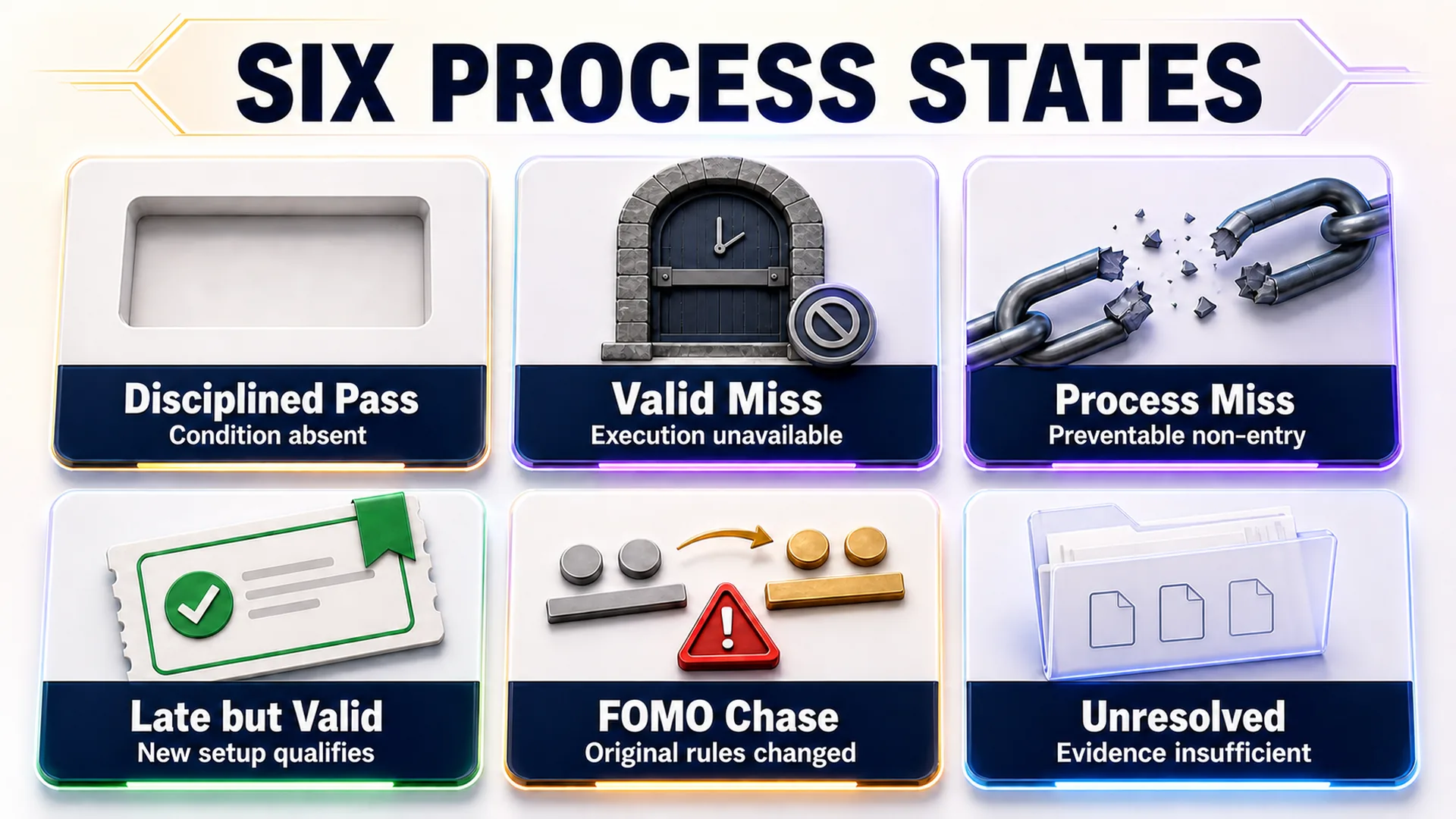
The label is useful only when the evidence can support it. The next step is therefore to capture what existed before hindsight arrived.
No. Live mentorship cannot replace your authorised trading plan, provider rules or independent judgement. It can provide an educational setting for practising evidence capture, process classification and risk discipline. Treat any later setup as a separate decision requiring its own conditions. Live AI-powered trading mentorship gives the relevant next learning step.
Build a Missed-Trade Journal Review
What evidence belongs in the first review?
Record the frozen plan, checklist version, exact decision time, entry window, invalidation, risk rule and contemporaneous chart before viewing the later path. Mark each required condition as met, absent or unverified. Then record whether spread, slippage, liquidity, platform access and attention made execution realistically available.
A written record is more testable than a memory reconstructed after a dramatic move.
A goal-monitoring meta-analysis found a general association between monitoring and goal attainment, with stronger effects when progress was physically recorded; it did not test trading journals or returns (Source: Harkin et al.).
Evidence-origin control: Tag each field as contemporaneous, system-recorded, reconstructed or unavailable. Contemporaneous notes and platform logs usually deserve more weight than memory written after the move, but they still need context. Preserve conflicting records and lower confidence. Keep the untouched chart source before adding annotations to a copy. A later screenshot can support outcome review but cannot prove what you knew earlier.
- Setup ID, instrument, session and exact decision timestamp.
- Frozen plan or checklist version.
- Contemporaneous screenshot, chart or data reference.
- Each required condition: met, absent or unverified.
- Planned trigger and authorised entry window.
- Original invalidation, stop, target and position-risk rule.
- Spread, slippage, liquidity, platform and data availability where relevant.
- Reason for non-entry, captured before outcome review.
- Emotional state described without self-diagnosis.
- Any notification, interruption or attention trigger.
- Pre-authorised secondary setup, if one existed.
- Whether a later entry was considered, rejected, simulated or executed.
- Every parameter changed after the first opportunity.
- Locked process label and evidence confidence.
- Later market path, stored separately and marked counterfactual when untraded.
- One proposed if-then response plus unresolved evidence.
Do not add a counterfactual profit figure. An unexecuted trade has no realised profit or loss. Once the first pass is sealed, examine the late decision without letting it borrow authority from the original setup.
Test the FOMO Chase Separately
When is a late entry still a new setup?
A late entry is valid only when a separately pre-authorised setup independently meets its own trigger, entry window, invalidation, execution and risk conditions. If you stretch the old entry, move the invalidation, change position risk or invent a reason after price runs, record a FOMO-chase candidate or leave the case unresolved.
The distance price has travelled does not create a universal rule. No admitted evidence establishes a fixed number of minutes, candles or pips that separates a valid late setup from a chase.
Your own pre-existing strategy must supply those thresholds. Without that authority, a precise number would be invented.
That distinction protects the original evidence boundary.
Evidence boundary: An FCA simulated trading-app experiment with more than 9,000 UK-based participants found that some attention and engagement cues increased trading frequency. It did not test live forex, missed trades or this framework. Record such cues as context, not as proof of motive (Source: Financial Conduct Authority).
Red-team check: Before approving a second setup, ask whether you would have recognised and named it if the first move had never happened. If not, the idea may be outcome-led. Give it a new setup ID, current invalidation and current risk conditions. Record FOMO trading as context only; do not diagnose motive. Check spread, liquidity and platform delay. Never attach changed terms to the expired opportunity merely because price continued.
- Give the later idea a new setup ID.
- Identify the pre-written rule that authorises it.
- Recheck entry, invalidation, execution and risk terms from zero.
- List every parameter changed after the first opportunity.
- If no independent setup qualifies, take no catch-up entry under the original ID.
SWIPE OR USE ARROW KEYS TO VIEW THE FULL IMAGE.

Attention cues may be relevant context, but they cannot determine motive or outcome. The next safeguard is to keep later price review in its proper lane.
Start with evidence, not feeling. A valid miss requires every pre-written condition to have held while a documented, non-preventable operational constraint made compliant execution unavailable. AI-assisted education can structure questions but cannot validate a specific setup or replace your judgement. AI Trading Co-Pilot education gives the relevant next learning step.
Outcome Bias Cannot Rewrite Process
How should later price action affect the review?
Reveal the later chart only after the process classification is locked. Use it to test setup assumptions, market behaviour and model calibration, not to reverse the decision-time verdict automatically. One favourable missed move does not prove the setup was valid, and one losing planned trade does not prove the process was invalid.
Outcome blindness is not outcome denial. Repeated, properly logged observations may expose a calibration question worth testing.
A single realised path cannot show what would have happened under different spread, slippage, management or exit conditions. Counterfactual results must remain visibly labelled as hypothetical.
Keep each calibration question separate from the original verdict.
Evidence boundary: Historical brokerage data associated very high stock-trading activity with lower net returns after costs, but the study covered US equity households from 1991–1996 and did not identify FOMO. It supports caution about unnecessary activity, not a numerical forecast for contemporary forex (Source: Barber and Odean). Review repeated cases only after the process labels are locked. Look for recurring evidence gaps or preventable actions while keeping profit and loss separate from rule adherence.
Red-team check: Hide the profit-and-loss result and ask whether the process label still stands. Do not upgrade a valid missed trade because price later reached a target or downgrade a compliant pass through trading-psychology language. If the later path exposes a recurring rules gap, open a separate calibration question and preserve the original verdict.
- Later market path and time window reviewed.
- Whether the original hypothesis was supported, contradicted or still unclear.
- What information was genuinely available at decision time.
- Any calibration question requiring a larger, governed sample.
- No strategy change from one example alone.
Calibration is now separate from process judgement; the final step is a bounded response rule that does not pretend to control the market.
Use a fixed checklist or a calm second review, but keep the original evidence unchanged and the final decision your own. Scalping Wolf Live’s transparency resources can support process-led reflection and accountability without validating a specific setup, diagnosing your emotion or promising a better trading result. Live trading and transparency articles gives the relevant next learning step.
Use a Missed-Trade Journal Rule
What rule protects the next trading decision?
Use this educational process rule: if the original entry window has closed or the setup has invalidated, then record the miss and take no catch-up entry under that setup ID. Consider another entry only when a separately pre-authorised setup independently qualifies. The rule controls process; it cannot promise a better market outcome.
Implementation-intention research supports pre-written if-then plans across varied non-trading goals, but the evidence cannot be transferred as a trading-performance effect (Source: Gollwitzer and Sheeran).
Treat the rule as a testable habit that creates a pause for evidence review, not a guarantee of emotional relief or a better market result.
A written pause cannot control price, but it can preserve which rule authorised your next decision.
Change-threshold control: Set a review threshold before changing any rule. This can be a minimum number of comparable, properly documented events chosen under your existing governance, not an invented universal trading number. Until that threshold is reached, record observations and questions rather than rewriting the strategy. If the journal repeatedly shows distress, compulsive behaviour or risk-control breaches, pause trading and seek appropriate professional support; an educational article cannot diagnose or treat a psychological condition.
- Percentage of journal fields completed before outcome review.
- Count of cases left unresolved when evidence was insufficient.
- Count of late decisions with a genuinely separate setup ID.
- Count of post-miss rule changes identified and reviewed.
- Repeated triggers that may justify a controlled process review.
SWIPE OR USE ARROW KEYS TO VIEW THE FULL IMAGE.
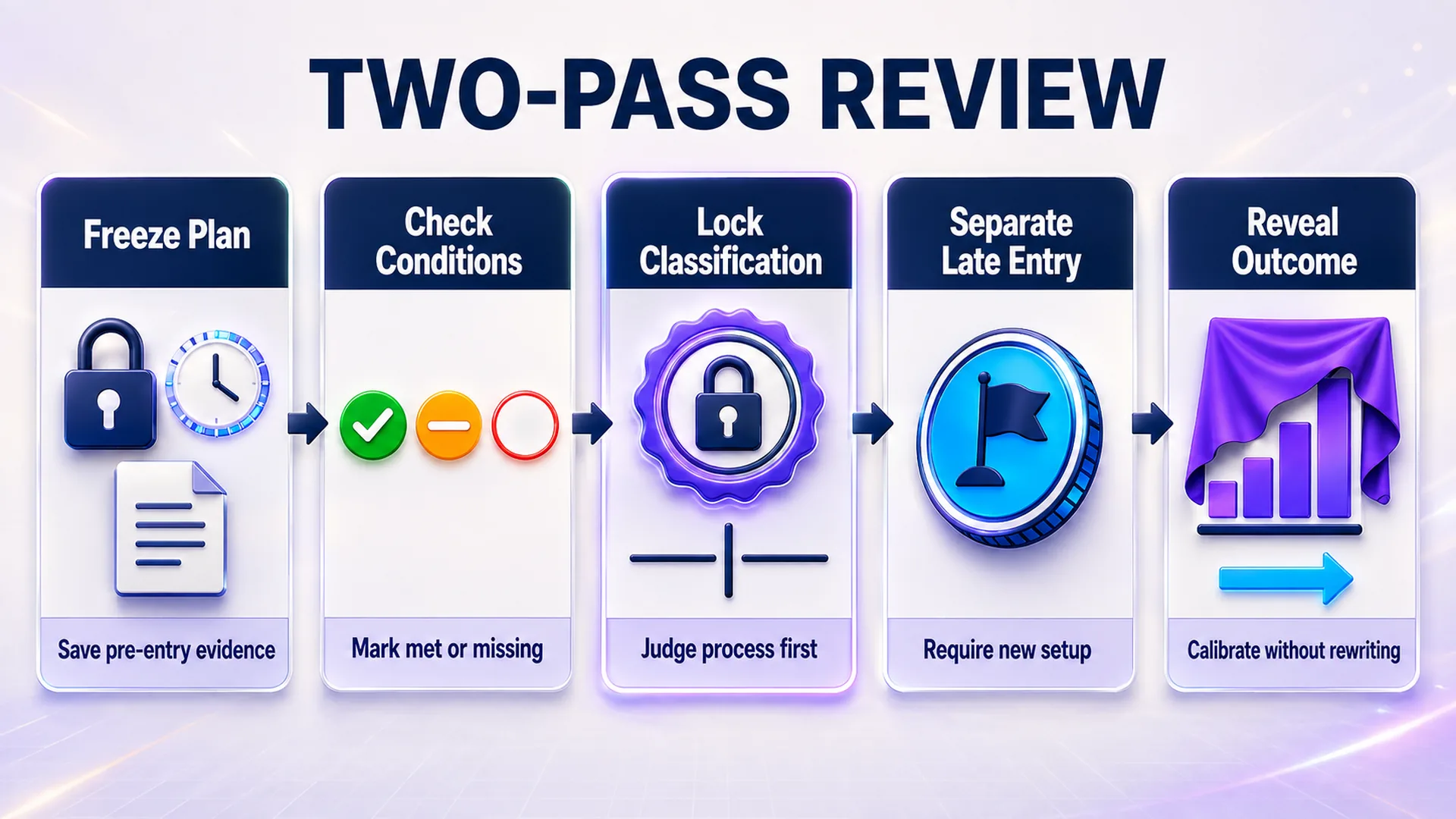
The framework asks for better records, not more trades, and leaves proprietary entry rules inside their authorised learning context.
Interactive reflection
Think about your last missed move. Could you reconstruct the original checklist without looking at what price did next? If not, write “unresolved” rather than awarding yourself discipline or blame. That honest gap is useful evidence.
Sources and References
- Baron and Hershey, Outcome Bias in Decision Evaluation — Behavioural decision experiments, not live trading.
- Aiyer et al., Outcomes Affect Evaluations of Decision Quality — Pre-registered replication using non-trading scenarios.
- Harkin et al., Does Monitoring Goal Progress Promote Goal Attainment? — Cross-domain monitoring evidence; no trading-return effect established.
- Financial Conduct Authority, Digital Engagement Practices: A Trading Apps Experiment — Simulated hypothetical trading app, not live forex.
- Barber and Odean, Trading Is Hazardous to Your Wealth — Historical US equity-brokerage context; no FOMO diagnosis or forex transfer.
- Gollwitzer and Sheeran, Implementation Intentions and Goal Achievement — Cross-domain if-then evidence; no validated trading-performance effect.
Scalping Wolf Live is an independent online trading education platform. All content — including blogs, live sessions, AI analysis, and mentorship materials — is strictly for educational purposes only and does not constitute financial advice, investment advice, or trading recommendations. Trading forex, indices, commodities, and cryptocurrencies involves significant risk. You may lose some or all of your invested capital. Past performance is not indicative of future results. Always consult a qualified financial advisor before making any trading decisions.
Ready to learn with funded traders — live?
Discord: https://discord.com/invite/5v8GJMncqV
Website: www.scalpingwolf.live
Frequently Asked Questions
Can you give me an example of a trade journal?
A missed-trade journal can record the setup ID, exact decision time, frozen checklist, chart evidence, entry window, invalidation, risk terms, execution conditions and reason for non-entry. Lock a valid miss or another process label before adding later price action. Keep hypothetical outcomes separate from realised trading results.
How can a trader respond to FOMO trading after a miss?
No journal can promise to remove FOMO. Create friction around unplanned action: close the original setup when its window expires, record the urge, and require a new setup ID before reconsidering entry. Review repeated triggers calmly and seek qualified support if distress or compulsive behaviour persists.
What is FOMO trading in a missed-trade review?
FOMO trading describes action driven by fear of missing a market move rather than by an unchanged, pre-written plan. Feeling urgency does not itself prove a FOMO chase. Compare the contemplated entry, timing, invalidation and risk terms with the original plan before classifying the decision.
Is FOMO bad for disciplined decisions after missed setups?
FOMO matters when it pulls your decision away from defined rules or encourages unnecessary activity. Its presence does not predict one trade result, and a profitable late entry can still breach process. Judge plan adherence and risk first, then examine the later outcome separately.
How do I create a trading journal for missed setups?
Begin with fields you can verify: setup identity, timestamp, checklist version, contemporaneous evidence, entry window, invalidation, risk, execution feasibility and reason for action or non-action. Add emotion as descriptive context. Lock the first-pass classification before revealing later price behaviour or calculating a hypothetical path.
What should a trading journal record after a missed setup?
A useful missed-trade journal contains evidence, rules, execution conditions, a reason for non-entry, a separate late-decision record, a process classification, confidence and missing-data fields. It also keeps later market movement in a second pass so hindsight cannot silently rewrite the original decision.
