





One-Tick Reality Check: Add Delay, Slippage and Limit-Fill Rules to a 1-Min Backtest
Expose hidden fill assumptions before a precise-looking backtest report shapes judgement.

On this page

Freeze one untouched backtest baseline, then test order delay, fixed-tick slippage, commission and limit-fill strictness in separate runs. Record every setting and compare individual orders, including fills that move, disappear or remain unchanged. These controls describe TradingView simulator behaviour; they do not measure broker latency, queue position, available liquidity or complete live costs. Forward testing can add observations as chart data updates, but it cannot by itself prove live execution, strategy edge, profitability or future performance.
- Freeze one untouched BASELINE-00.
- Change one simulator assumption per run.
- Compare moved, missing and unchanged fills.
- Keep broker execution and live equivalence unproved.
Use a frozen baseline, record each simulator setting and change only one execution assumption per comparison. That makes differences traceable, but it cannot turn chart-data simulation into proof of broker fills, profitability or a universally realistic configuration. Scalping Wolf Live’s registered one-minute rules page is a relevant educational example of explicit, repeatable rule structure. Review one-minute scalping rules gives the relevant next learning step.
A one-minute chart can look exact while concealing the rule that created each simulated fill. A touched limit and orderly report can change after one setting moves. This guide gives you a reproducible audit: preserve the original, change one variable, keep every outcome and state what remains unknown.

Define the Simulation Evidence Boundary
What can a one-minute backtest actually establish?
A one-minute backtest can compare strategy behaviour on historical chart data under recorded emulator assumptions. It can show sensitivity when one documented input changes. It cannot establish a live broker fill, measured latency, executable quantity, queue priority, strategy edge, profitability or a universally correct configuration.
TradingView distinguishes backtesting on historical data from forward testing while chart data updates. Both are platform test modes, not authenticated broker execution records. The National Futures Association separately cautions that hypothetical results have inherent limitations, but that United States rulebook source is cited narrowly and is not presented as UK legal advice.
Evidence record: Historical report · What it can show: Behaviour under named settings · What remains unproved: Actual routing and execution
Evidence record: Forward-test report · What it can show: Behaviour as chart data updates · What remains unproved: Broker-side orders and fills
Evidence record: Candle touching a price · What it can show: Price appeared in chart data · What remains unproved: Queue, quantity or partial execution
Evidence record: Authenticated broker record · What it can show: One observed order path · What remains unproved: Universal future behaviour
Source: TradingView, “What are strategies, backtesting and forward testing?” — https://www.tradingview.com/support/solutions/43000562362-what-are-strategies-backtesting-and-forward-testing/
Source: National Futures Association, “Compliance Rule 2-29” — https://www.nfa.futures.org/rulebooksql/rules.aspx?RuleID=RULE%202-29&Section=4
Call every result conditional on its code, data, period and settings. With those evidence labels fixed, freeze every baseline field before changing one.
Freeze the Untouched Baseline
Which settings belong on the baseline card?
Record platform and code versions, symbol, feed, session, timeframe, test range, chart type, historical detail, calculation timing, tick size, delay, slippage, commission, limit-fill mode and export identifier. Save the original before editing. Mark any unsupported value
DATA_NOT_AVAILABLE; never recreate it from memory.
TradingView documents delay, slippage, commission and limit-order execution as separate broker-emulator controls. Its strategy manual also describes historical-fill assumptions and report properties. These fields make a comparison reproducible inside the platform; they do not prove that defaults are neutral or that recorded settings match a broker, data feed or venue.
BASELINE-00 field: Platform and code version · Record: Exact version or hash · Evidence location: Source file and export
BASELINE-00 field: Symbol, feed and session · Record: Exact identifiers · Evidence location: Chart properties
BASELINE-00 field: Timeframe, range and chart type · Record: Exact values · Evidence location: Report properties
BASELINE-00 field: Tick size and historical detail · Record: Value or DATA_NOT_AVAILABLE · Evidence location: Instrument and strategy settings
BASELINE-00 field: Calculation and order timing · Record: Exact mode · Evidence location: Strategy settings
BASELINE-00 field: Slippage and commission · Record: Value, unit and mode · Evidence location: Settings and account evidence
BASELINE-00 field: Limit-fill rule · Record: Exact mode or ticks beyond · Evidence location: Strategy settings
BASELINE-00 field: Export identifier · Record: Filename, timestamp and hash · Evidence location: Immutable register
Source: TradingView, “Broker emulator” — https://www.tradingview.com/support/solutions/43000786181-broker-emulator/
Create four branches—DELAY-01, SLIPPAGE-01, COMMISSION-01 and LIMIT-01—from the same protected baseline. Never overwrite BASELINE-00.
The unchanged reference prevents hindsight from becoming an invisible setting. Once BASELINE-00 is fixed, isolate timing without changing costs or fill strictness.

Choose education that makes entry logic, timing assumptions and review steps explicit before looking at the outcome. That supports disciplined comparison, but it does not prescribe a trade, prove a strategy advantage or establish live-execution realism. The registered Wolf Strike page offers the closest first-party learning path for structured scalping rules and discipline. Study the Wolf Strike learning path gives the relevant next learning step.
Add Order Delay Deliberately
How does one-tick delay alter simulated timing?
DELAY-01changes only the documented order-delay setting and compares every order withBASELINE-00. One tick is a simulator timing option, not measured network, broker, queue or venue latency. Retain moved, missing and unchanged fills so the comparison does not favour a convenient outcome.
TradingView’s Pine Script manual explains next-tick order timing and the alternative of processing an order on a bar’s closing tick. The mechanism concerns simulated eligibility, not infrastructure speed. A fictional example can clarify the sequence, but it supplies no evidence about a real trader, account or order path.
Order record: Order identifier · BASELINE-00: Hold constant · DELAY-01: Same identifier · Audit label: Traceable
Order record: Creation bar or time · BASELINE-00: Record · DELAY-01: Hold constant · Audit label: No inferred timestamp
Order record: Simulated fill · BASELINE-00: Record · DELAY-01: Record · Audit label: Moved, missing or unchanged
Order record: Other assumptions · BASELINE-00: Frozen · DELAY-01: Frozen · Audit label: No mixed test
Order record: Broker latency · BASELINE-00: DATA_NOT_AVAILABLE · DELAY-01: DATA_NOT_AVAILABLE · Audit label: Separate evidence needed
Imagine a clearly fictional order created at a one-minute bar close. The delay variant moves its eligible simulated fill to a later event, while every other field remains fixed. You can conclude only that the result is sensitive to the platform timing rule—not that the later fill is more realistic.
Source: TradingView, “Strategies”, Pine Script manual — https://www.tradingview.com/pine-script-docs/concepts/strategies/
Timing asks when an eligible simulated order may execute. Limit verification asks what price movement makes it eligible. After timing is isolated, reset to BASELINE-00 and test price friction and fees separately.
Stress-Test Slippage and Commission
What changes when costs enter the model?
Run two separate comparisons.
SLIPPAGE-01changes only fixed-tick slippage;COMMISSION-01changes only the recorded commission mode and amount. Each value is a model input, not measured live cost. Neither run automatically captures spread, liquidity, market impact, rejection, partial fills or every account charge.
TradingView documents slippage in fixed ticks and commission as percentage, fixed-per-order or per-contract modes. Its manual says real-world slippage is dynamic and unpredictable, so a fixed input cannot reproduce it precisely. It also warns that excessive constant slippage can place simulated fills outside a candle’s range and make results unrealistically worse.
Ledger: SLIPPAGE-01 · Only changed field: Fixed-tick slippage · Record: Ticks, minimum tick and affected orders · Interpretation ceiling: Sensitivity to one price adjustment
Ledger: COMMISSION-01 · Only changed field: Commission · Record: Mode, amount, currency and units · Interpretation ceiling: Sensitivity to one fee rule
Ledger: Empirical calibration · Only changed field: None in this run · Record: DATA_NOT_AVAILABLE where unsupported · Interpretation ceiling: No claimed live-cost match
Retain adverse, favourable and unchanged order-level differences. A harsher-looking report is not automatically more accurate. Reset to the protected baseline before each test.
Modelled timing, price and fees still do not answer whether a touched limit was executable. That requires a separate eligibility comparison.
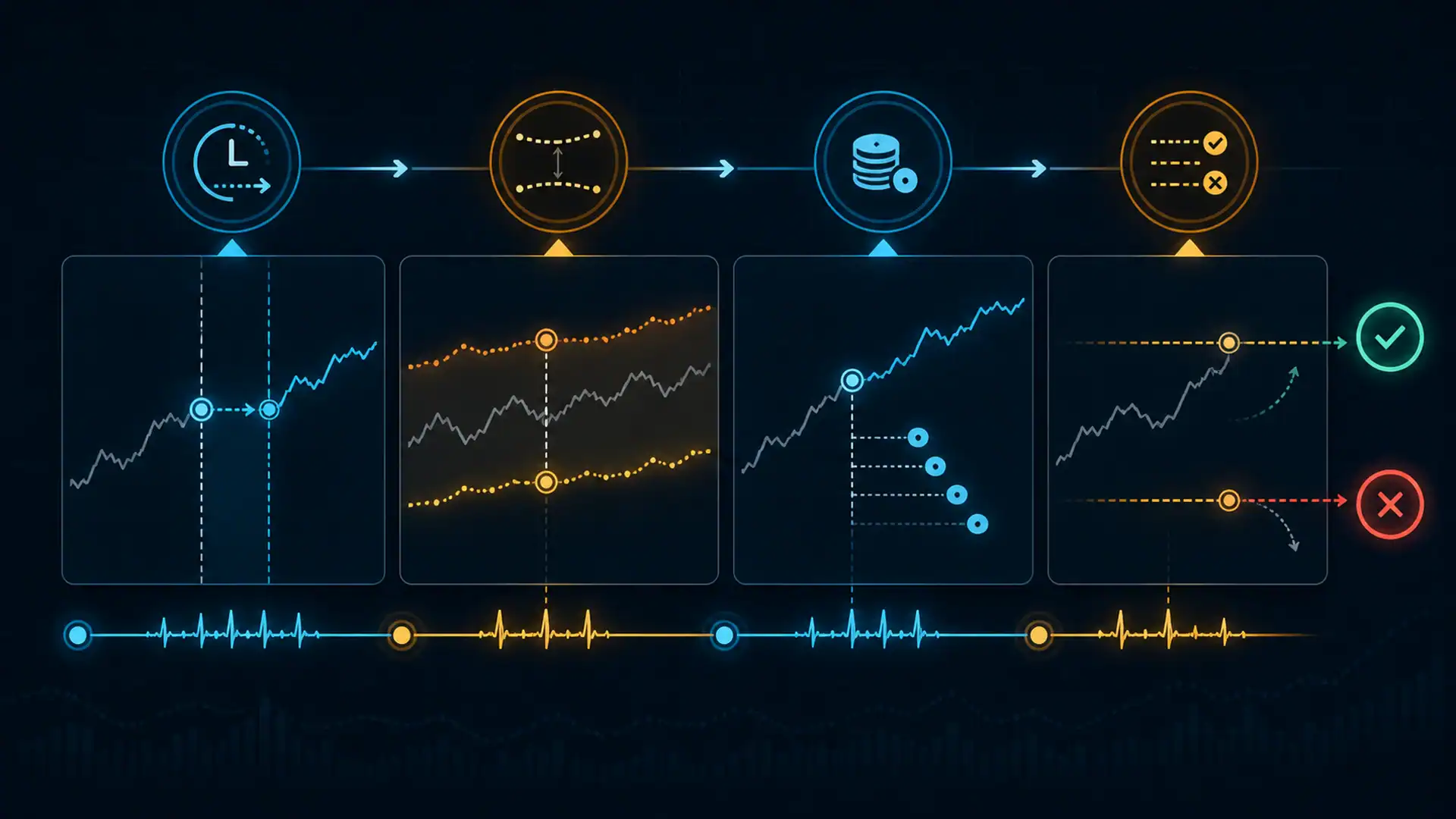
A report shows outputs under its recorded code, data and simulator assumptions; it does not automatically reveal whether those assumptions are complete or live-realistic. Further education can help you question the evidence boundary without rewriting the result. The registered Scalping Wolf Live Blog is a relevant first-party route for continuing that evidence-aware review. Continue evidence-aware trading education gives the relevant next learning step.
Separate Touch From Limit Fill
When does a touched limit become a fill?
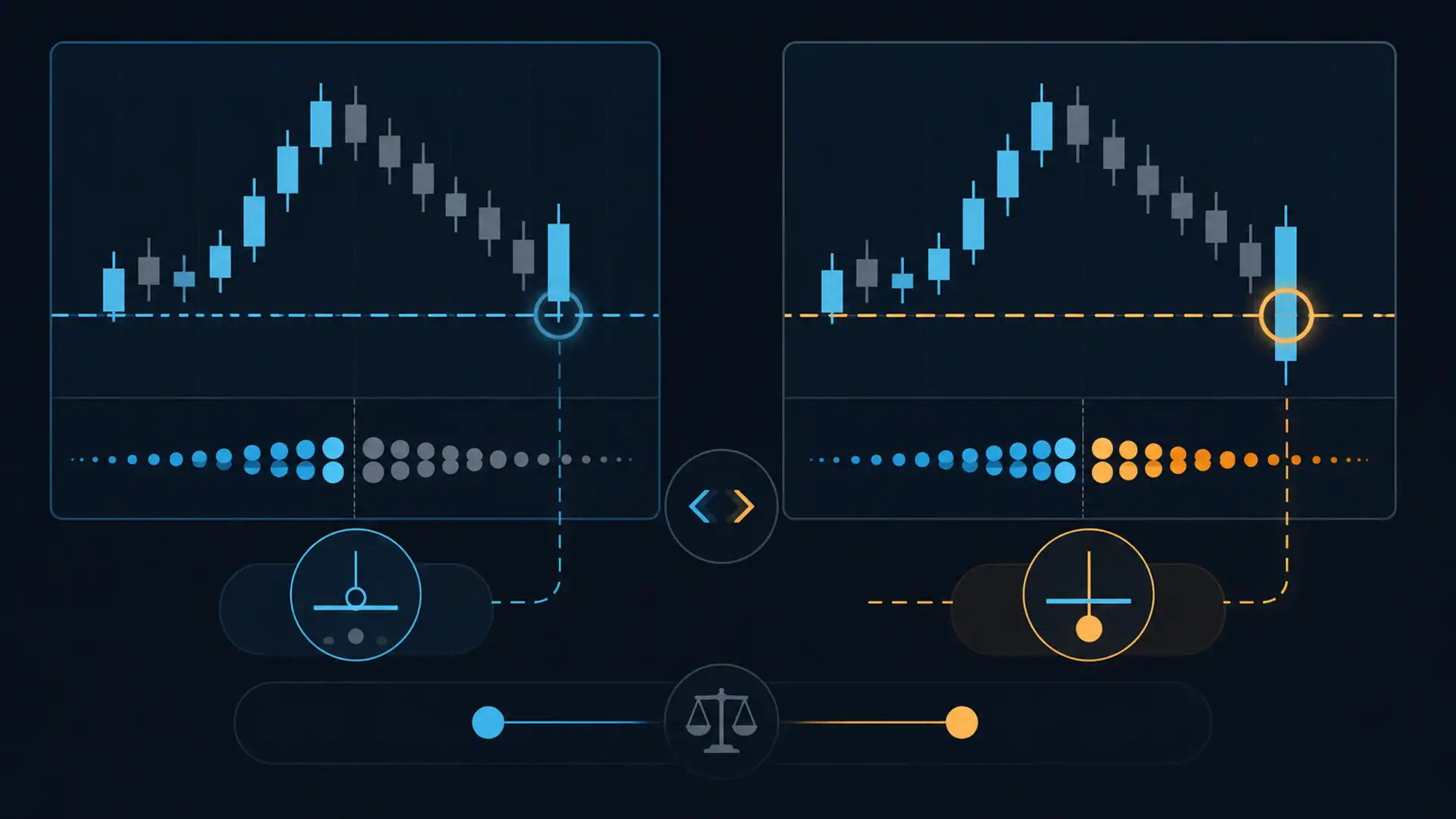
Requested-price mode and one-tick-beyond mode apply different simulator eligibility rules. Compare both from
BASELINE-00and record orders that disappear, move or remain unchanged. Neither rule proves live queue priority, available size, liquidity, rejection, price improvement or partial execution for an actual order.
TradingView documents one mode in which reaching the requested price is sufficient and another requiring price to move one tick beyond the level before the emulator fills at the requested price. Lower-timeframe historical detail can add price points when available, but it still cannot reconstruct an order book, queue or executable quantity.
Order field: Order identifier · Requested-price run: Same · One-tick-beyond run: Same · Evidence gap: None for comparison
Order field: Limit level and bar range · Requested-price run: Record · One-tick-beyond run: Hold constant · Evidence gap: Intrabar queue unknown
Order field: Eligibility rule · Requested-price run: Price reaches level · One-tick-beyond run: Price moves one tick beyond · Evidence gap: Platform-specific logic
Order field: Simulated status · Requested-price run: Fill or no fill · One-tick-beyond run: Moved, missing or unchanged · Evidence gap: Live execution unproved
Order field: Quantity and partial fill · Requested-price run: DATA_NOT_AVAILABLE · One-tick-beyond run: DATA_NOT_AVAILABLE · Evidence gap: Broker evidence required
Interactive fictional scenario: A one-minute candle touches a limit. Requested-price mode records a fill, while one-tick-beyond mode does not. Which evidence would you seek before calling it filled: the chart range, both emulator outputs, or an authenticated broker order-and-fill record? The scenario describes no real trade or student.
Do not rename one-tick-beyond as a universal worst case. The final comparison can now observe chart-data behaviour while preserving the broker-evidence gap.
Compare Forward Evidence Carefully
What can forward testing verify about execution?
Forward testing can reveal how a TradingView strategy and broker emulator behave as chart data updates, including matches, mismatches and non-fills. It cannot by itself prove broker routing, queue position, live latency, liquidity, universal transferability, strategy edge, profitability or future performance. Authenticated execution needs separate evidence.
TradingView says strategy parameters can change both historical and forward-test results. The NFA rulebook provides a narrow official caution about hypothetical performance, but it supplies no TradingView configuration and no UK applicability conclusion. Agreement remains sample-bound; disagreement becomes an evidence question rather than a story about why it occurred.
Record: Frozen reference · Required entry: BASELINE-00, hash and complete settings
Record: Isolated variants · Required entry: DELAY-01, SLIPPAGE-01, COMMISSION-01, LIMIT-01
Record: Forward observation · Required entry: Time, chart state and emulator configuration
Record: Outcome label · Required entry: Match, mismatch, non-fill or unknown
Record: Confirmed difference · Required entry: What changed, without invented cause
Record: Next evidence · Required entry: Broker record, fee terms or other exact missing source
Preserve matches and mismatches equally. No script, dataset, spread series, commission schedule, order size or broker fill record was supplied, so no performance result or preferred value is available.
Every conclusion should read: under this recorded code, dataset, period and set of fill assumptions, this order-level difference appeared. That closes the audit without upgrading simulation to market fact.

Which evidence is still missing before a touched limit can be called filled?
Which fill assumption needs the clearest evidence?
Sources
- TradingView — Broker emulator (reviewed 2026-08-26)
- TradingView — What are strategies, backtesting and forward testing? (reviewed 2026-08-26)
- TradingView — Strategies — Pine Script manual (reviewed 2026-08-26)
- National Futures Association — Compliance Rule 2-29 (reviewed 2026-08-26)
Risk warning: Scalping Wolf Live provides trading education, mentorship, and live analysis content for informational purposes only. Nothing published by Scalping Wolf Live constitutes financial advice, investment advice, or a recommendation to buy or sell any financial instrument. Trading foreign exchange and derivatives carries significant risk of loss and is not suitable for all investors. Past performance shown in live sessions or case studies is not indicative of future results. You are solely responsible for your own trading decisions.
FAQs
Is one tick of delay the same as broker latency?
Does fixed slippage model every live trading cost?
Can a candle touch prove my limit order filled?
Should commission and slippage be tested together?
Does forward testing prove my backtest is realistic?
What should remain unknown after a fill-assumption audit?
Yes. Basic forex and execution vocabulary helps you separate chart prices, simulated eligibility and broker evidence before interpreting a result. It will not determine your actual queue position, available liquidity, costs or whether a live order would execute. The registered Introduction to Forex Trading page is a suitable first-party foundation for that learning step. Build your forex foundations gives the relevant next learning step.
