





Catch the Impulse Before You Click: A Trading Pre-Commitment Checklist
A calm, evidence-led process for checking setup, invalidation, context and cancellation before one intended order.
Notice the pre-click state, compare the order with the written plan and cancel when material conditions have changed.

On this page

This guide does not diagnose or promise to remove that moment. It gives you a checkpoint for one order: compare the click with evidence written before the pressure arrived. The crucial branch lets you cancel and reassess when conditions change.
- What does Scalping Wolf Live do and how can it help me right now?
- Want a calm place to discuss process, evidence and accountability? Join the Scalping Wolf Live Discord community: https://discord.com/invite/5v8GJMncqV
Raheel Ahmed Rathore, founder of Scalping Wolf Live, writes this practical guide to help rule-aware traders examine the moment before an intended order.
A trading pre-commitment checklist is a short, revocable checkpoint that compares an intended order with evidence written before the moment. Name the setup, confirm its invalidation, check position size against your existing boundary, verify timing and context, then ask whether the reason to act comes from the plan or from urgency. Choose PROCEED, WAIT or SKIP. If required evidence is missing or conditions have changed, use CANCEL_AND_REASSESS. This is an educational process aid, not an entry signal or a proven performance intervention.
You know the rule. Your cursor still drifts towards the order button. Price is moving, and the quiet sentence becomes: if I wait, I will miss it. That gap between knowing and acting can feel frustrating when you recognise it in real time.
A useful education platform can help you inspect the language of a written process and compare it with prior evidence, but it cannot decide whether you should place an order. The setup, boundaries and final decision remain your responsibility. Scalping Wolf Live’s rules-based scalping category is a relevant next step for comparing a fast pre-click process with explicit educational rules, without approving an order. Explore rules-based one-minute scalping education gives the relevant next learning step.
The Seconds Before an Unplanned Click
Scalping Wolf Live provides trading education and live learning support. For this pre-click problem, its role is accountability around your written process, not a replacement instruction. Compare the intended order with your existing rules, then use the education hub for structured learning.
How can live mentorship support a pre-trade routine?
Live mentorship can provide a structured setting to discuss how a routine fits your plan. It cannot decide whether an order is valid. Use it as education: bring written setup, invalidation and review notes to the Scalping Wolf Live live mentorship page.
If you want structured education around planning and review, explore Scalping Wolf Live live mentorship: https://scalpingwolf.live/live-mentorship/
I’m a rule-aware intraday trader and still rush clicks — what should I practise?
Practise noticing the activation cue and reading five questions before one intended order, first in review or a demo setting. Record the decision without judging yourself. The Scalping Wolf Live Trading Pack supports wider learning; your written plan remains the authority.
Build your wider learning routine around evidence and review with the Scalping Wolf Live Trading Pack: https://scalpingwolf.live/the-trading-pack/
Can a checklist fit a fast scalping process?
It can fit when the setup and response were defined before the fast moment. The card should confirm evidence, not invent a delay or entry rule. Explore the Scalping Wolf Live Wolf Strike Scalping overview for wider education, not a signal.
For more educational context, watch Scalping Wolf Live market and learning videos on YouTube: https://www.youtube.com/@Scalping_Wolf_Live
The Seconds Before an Unplanned Click
Why do trading rules disappear before a click?
Trading rules do not literally disappear; attention can narrow around the immediate order while written evidence receives less weight. Treat the pre-click state as an observable process moment, not a diagnosis or character verdict. Your job is to notice the shift before submission and compare the order with the plan already on the page.
The research boundary matters here. A 1999 institutional record defines an implementation intention as an if-then plan linking a situation to a response (Source: University of Konstanz). That general definition does not show that a trading checklist works, but it offers a precise way to write a cue without inventing a clinical explanation.
Fast Setup or Impulse? Check Evidence
Imagine a fictional trader called Alex watching price reach a marked level. The plan requires confirmation, but Alex reaches for the mouse before it appears. That does not prove an impulse; it creates a reason to check.
This article owns the seconds before one order. Post-loss revenge recovery belongs to its separate reset process, while session shutdown and end-of-session journalling belong to their own established owners.
Educational boundary: the card is not diagnosis, treatment, therapy, a trading signal or personalised risk guidance.
Once you can name the moment without judging it, the next question is whether the trade was already valid.
Fast Setup or Impulse? Check Evidence
How can you separate speed from trading impulse?
Speed alone cannot tell you whether an order is planned or impulsive. Compare the click with evidence written before the moment: a named setup, defined invalidation, permitted position size, allowed timing and relevant market context. A genuinely pre-planned fast setup may pass; an urgent story without those fields should not borrow the plan’s authority.
CME Group education asks traders to define setup, trigger, exit, stop, target and planned risk before entry (Source: CME Group). That is educational guidance, not proof that this card changes behaviour, and its example indicators or percentages are not universal rules. Use only the fields already defined in your own tested plan.
In one rehearsal, confirmation appears as written, invalidation is unchanged, size remains inside the boundary and context is permitted. A quick PROCEED can match the plan because its evidence existed earlier.
In another, price has left the planned area. Alex widens invalidation and says the move is too strong to miss. Speed is not decisive; the missing evidence match is.
Use a five-field comparison: named setup; invalidation or stop condition; position size or planned risk; timing and context; reason to act now.
If a required field is missing or changed, use CANCEL_AND_REASSESS. Do not submit the prior intention; this guide supplies no replacement setup.
Evidence can distinguish the two rehearsals, but it becomes easier to use when the trigger is written in advance.
Write the Trigger Before Pressure
Education can help you make setup, invalidation, context and execution rules easier to inspect before a click. It should not approve an order, replace your plan or turn the card into an automatic signal. Scalping Wolf Live’s one-minute rules guide is a relevant next step for examining how explicit rules support review in a fast execution setting. Review the one-minute scalping strategy rules gives the relevant next learning step.
Write the Trigger Before Pressure
How should a pre-click trading trigger be written?
Write one observable if-then cue that starts a review rather than an order. For example: if I notice urgency replacing written setup evidence, then I will read my five-question card before touching submit. Keep the response revocable, short and tied to your existing plan. It must never automate or authorise an entry.
In a 2013 delayed-reward laboratory task, precommitment supported larger-later choices relative to willpower (Source: UCL Discovery). The experiment did not test trading, rule adherence, this checklist, losses or profitability. Its value here is a bounded design question: can the review cue be selected before the pressured moment rather than improvised inside it?
Alex chooses an observable cue: if I say I must act before the next candle, then I will check the five fields. It opens a review without declaring the trade wrong.
Avoid vague, judgemental cues and responses that invent a new entry or size rule.
Three tests keep the cue bounded: observable in the moment; linked to review, not entry; cancellable when conditions change.
Write the trigger before the session and rehearse it without an order.
The trigger opens the door; the five questions decide which evidence must be present on the other side.
Use the Five-Question Pre-Commitment Card
What should a trading pre-commitment checklist ask?
A trading pre-commitment checklist should ask whether the intended order matches a named setup, keeps its original invalidation, stays inside written size boundaries, fits permitted timing and context, and rests on evidence that existed before urgency. The answers route to PROCEED, WAIT, SKIP or the mandatory changed-conditions branch: CANCEL_AND_REASSESS.
The five-question card is a governed editorial synthesis, not a validated trading intervention. Its ingredients combine the if-then definition, pre-entry plan fields and evidence about flexibility when contingencies change. That source lineage supports cautious testing of a review process only; it does not support automatic entries, personalised settings or performance claims.
Question 1 — Setup: Can I name the exact pre-written setup this order belongs to?
Question 2 — Invalidation: Is the original invalidation or stop condition present and unchanged?

Use the Five-Question Pre-Commitment Card
Question 3 — Boundary: Is position size and planned risk inside my existing written limit?
Question 4 — Context: Are timing, market context and any material conditions still permitted?
Question 5 — Evidence: Does my reason to act come from evidence recorded before this moment rather than urgency alone?
PROCEED means every field matches. WAIT means evidence may develop. SKIP means the opportunity is absent. CANCEL_AND_REASSESS means evidence is missing or changed; cancel the prior intention without treating this article as a signal.
A clean card is useful only if you also rehearse the moments when it should refuse to give a simple answer.
Why the Card Can Still Fail
When can a pre-click checklist give false confidence?
A checklist can create false confidence when you rewrite answers to fit the desired order, treat a profitable outcome as proof of good process, or keep an old response after conditions change. Research on precommitment is mixed across different tasks. The card must remain revocable, record overrides and preserve a clear cancellation branch.
A 2024 laboratory paper reported more commitment selection and larger-later choices under its tested revocable-precommitment conditions (Source: Oxford Academic). A separate 2026 deadline replication found negligible effects across its three main performance measures (Source: Psychological Science). These studies tested different interventions and outcomes; neither tested trading or this card.
Late chase: price has left the planned area and invalidation needs changing. Use CANCEL_AND_REASSESS, not a creative reinterpretation.
Post-loss urge: check only the intended click, then hand revenge-trading recovery to its separate established owner.
Valid fast setup: every field matches earlier evidence. The card may return PROCEED without predicting the outcome.
A 2023 non-trading instrumental-learning study found that implementation intentions could support early learning yet reduce later performance when contingencies changed (Source: Quarterly Journal of Experimental Psychology). This does not show harm to traders; it supports keeping reassessment available.
The honest test is therefore not whether the next order wins, but whether the checkpoint was used as written.

No checklist can promise a fix. It can make the pre-click evidence and any override easier to review, while leaving every setup, boundary and decision inside your existing written plan. Changed conditions still require cancellation and reassessment. Scalping Wolf Live’s psychology articles offer relevant further education about discipline and review without promising a trading outcome. Continue with trading psychology education gives the relevant next learning step.
Why the Card Can Still Fail
Review the Checkpoint, Not P&L
How should you review a pre-trade checklist?
Review whether you noticed the trigger, answered each question from pre-existing evidence, chose the recorded decision and respected any cancellation branch. Keep immediate profit and loss separate from process adherence. Change the card only after repeated process observations reveal a specific weakness, and preserve counterexamples that challenge your preferred story.
The Financial Conduct Authority tested four digital engagement practices with more than 9,000 consumers and found that some cues changed trading frequency and investment risk in its online experiment (Source: Financial Conduct Authority). That consumer-investment setting is not every platform or forex market, but it reinforces the importance of recording which interface cue preceded your decision.
Journal five fields: trigger, answers, decision, override and reason. Record outcome later, but never let a win excuse a broken rule or a loss condemn an adherent process.
Look for repeated process evidence and examples that disprove your first explanation.
Revise one field at a time and test the wording in review or a no-stakes setting. No universal review period is established here.
End-of-session analysis and any decision to stop trading remain with the established session-shutdown and journalling owner, not this single-order checklist.
That separation between evidence, decision and outcome is what keeps a simple card from becoming a comforting story.
📝 Reflection: Think about three recent intended orders without judging the results. What words appeared immediately before each click, which plan evidence already existed, and did any material condition change? Write the answers in three columns. The aim is to observe your process, not diagnose yourself or prove that the card works.
IMMEDIATE — Write one observable if-then cue that opens the five-question review rather than authorising an order.
THIS SESSION — Rehearse the card once in review or a demo setting and record PROCEED, WAIT, SKIP or CANCEL_AND_REASSESS.
THIS WEEK — Compare repeated process notes, preserve counterexamples and discuss education or accountability in the Scalping Wolf Live Discord without sharing personal account data.
Scalping Wolf Live is an independent online trading education platform. All content — including blogs, live sessions, AI analysis, and mentorship materials — is strictly for educational purposes only and does not constitute financial advice, investment advice, or trading recommendations. Trading forex, indices, commodities, and cryptocurrencies involves significant risk. You may lose some or all of your invested capital. Past performance is not indicative of future results. Always consult a qualified financial advisor before making any trading decisions.
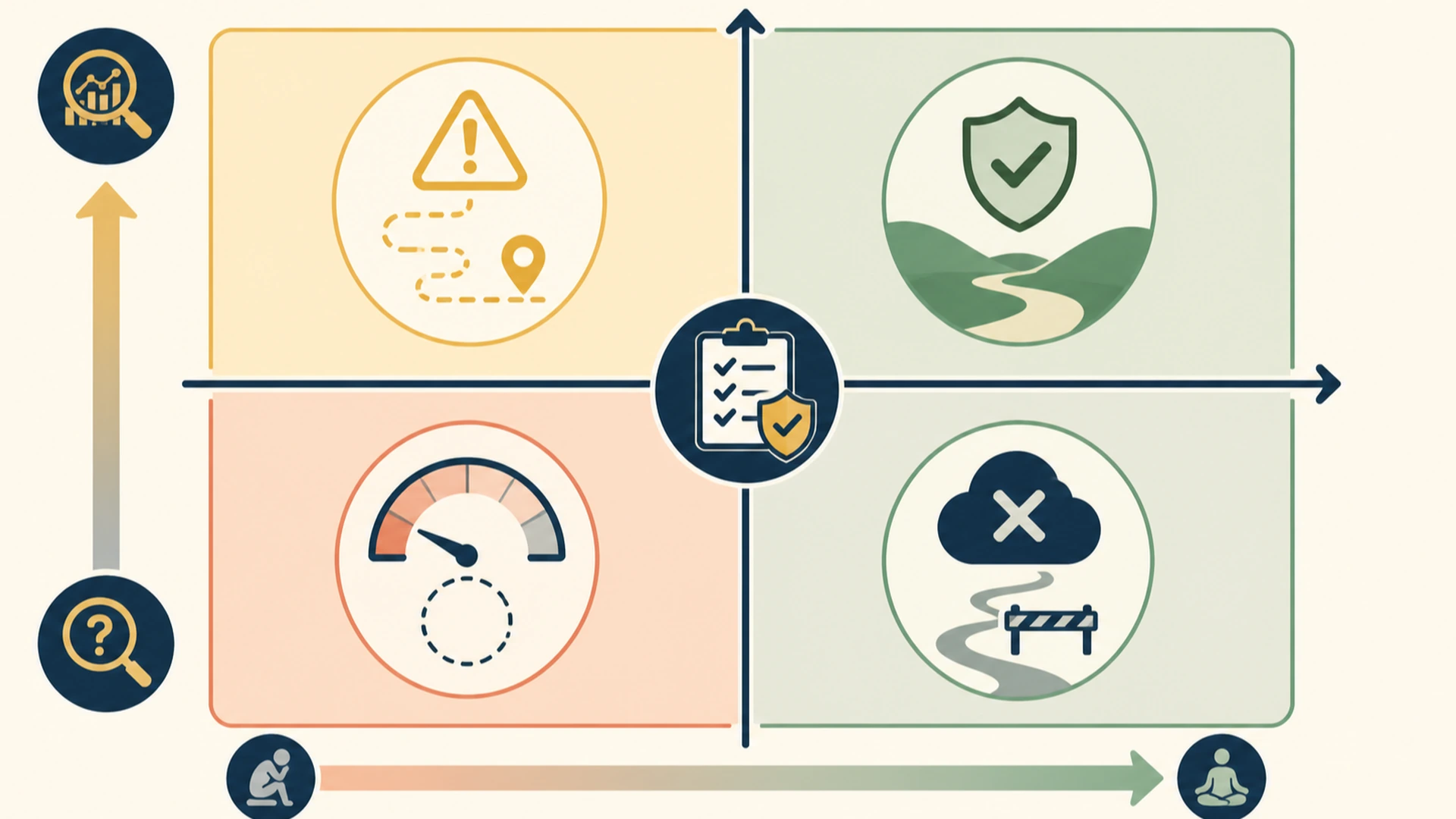
Begin with a written, fictional or non-live rehearsal. The aim is to understand the cue, questions and cancellation branch before pressure appears, not to prove readiness through a live order or turn practice into a performance test. The Scalping Wolf Live blog is a relevant next step for self-paced educational reading while you refine the process independently. Browse further Scalping Wolf Live education gives the relevant next learning step.
Review the Checkpoint, Not P&L
What is a trading pre-commitment checklist?
A trading pre-commitment checklist is a short checkpoint written before pressure rises and used before one intended order. It compares the click with your existing setup, invalidation, size and context rules. It is not a signal or a proven performance tool, and it should always retain a cancellation and reassessment branch.
How do I know a fast trade was planned?
Use evidence that existed before the moment: a named setup, original invalidation, permitted context and written risk boundary. Speed alone is not the test. A fast order can still be planned, while a slower order can still lack evidence. Record the match rather than judging the eventual result.
Can a pre-click checklist make me miss entries?
It may add friction, so keep the card concise and test it cautiously in review or a no-stakes setting. No fixed pause suits every setup. A genuinely pre-defined fast setup can return PROCEED when all required evidence matches, but this article cannot promise any effect on entries or performance.
What should I do when conditions have changed?
Use CANCEL_AND_REASSESS when a required field is missing or a material condition has changed. Do not submit the prior intention. Return to your existing plan and reassess the new situation. Only a separately valid setup satisfying those pre-written rules can return to PROCEED; this guide supplies no replacement entry.
Should I judge the checklist by profit and loss?
No. Immediate profit and loss cannot establish whether the process was sound. Review whether you noticed the cue, answered from pre-existing evidence, followed the recorded decision and respected cancellation. Keep the outcome as a separate observation, then revise only when repeated process evidence identifies a specific weakness.
Raheel Ahmed Rathore is the founder of Scalping Wolf Live. This candidate intentionally omits credential claims because a current credential evidence receipt was not included in the isolated lane’s authorised input bundle.
Research support: Sadaf Javed — Digital Media Team, SHC Group.
Treat every pause as a recordable process observation, not a promise of control. It cannot predict outcomes, remove market risk, validate an untested setup, or prove that a particular order should be placed in markets.
Use the card as education and process documentation. It cannot validate an order, remove uncertainty, control the market, or predict a result.

📊 Quick poll
Which part of your pre-click process needs the clearest written evidence?
Sources
- HYB-S01 — HYB-S01 (reviewed 2026-08-11)
- HYB-S02 — HYB-S02 (reviewed 2026-08-11)
- HYB-S03 — HYB-S03 (reviewed 2026-08-11)
- HYB-S04 — HYB-S04 (reviewed 2026-08-11)
- HYB-S05 — HYB-S05 (reviewed 2026-08-11)
- HYB-S06 — HYB-S06 (reviewed 2026-08-11)
- HYB-S07 — HYB-S07 (reviewed 2026-08-11)
FAQs
What is a trading pre-commitment checklist?
How do I know a fast trade was planned?
Can a pre-click checklist make me miss entries?
What should I do when conditions have changed?
Should I judge the checklist by profit and loss?
